A2 · EDI vs Mixed-Bed Polisher: How to Choose for Semiconductor, Pharma & Power
By Ella Liu — Industrial Water Treatment Specialist at Rong Water · [email protected]
The 30-second answer
At the polishing stage of an ultrapure train you have two real options: electrodeionization (EDI) or a mixed-bed (MB) polisher. If you’re making water that rinses a chip, feeds an injectable-drug line, or tops up a high-pressure boiler, this is the fork you’ll stand at.
Here’s the short version:
- EDI regenerates itself electrochemically. No acid, no caustic. It runs continuously and delivers 15–18.2 MΩ·cm — for most ultrapure duty, that’s the modern default.
- Mixed bed holds a rock-steady 18.2 MΩ·cm with a marginally higher purity ceiling. But it’s a batch process: every few weeks it comes offline for regeneration with acid and caustic, which means chemical storage, neutralisation and an environmental permit.
For most new plants, EDI wins on OPEX, reliability and safety. A mixed bed still earns its place at the very top of the spec — holding 18.2 MΩ·cm for semiconductor UPW — but usually behind an EDI, guarding the final spec rather than doing the whole job.
The rest of this article walks the comparison so you can pick which one — or which combination — fits your duty.
Where the choice sits in the ultrapure train
Raw water → pretreatment → UF → RO → [POLISHING STAGE] → point of use
                                        ▲
                             EDI  OR  mixed bed (or both)
RO gets you to roughly 2–10 μS/cm. The polishing stage — EDI or mixed bed — closes the last gap down to the single-digit-microsiemens-to-18-MΩ range that pharma, semiconductor and power demand.
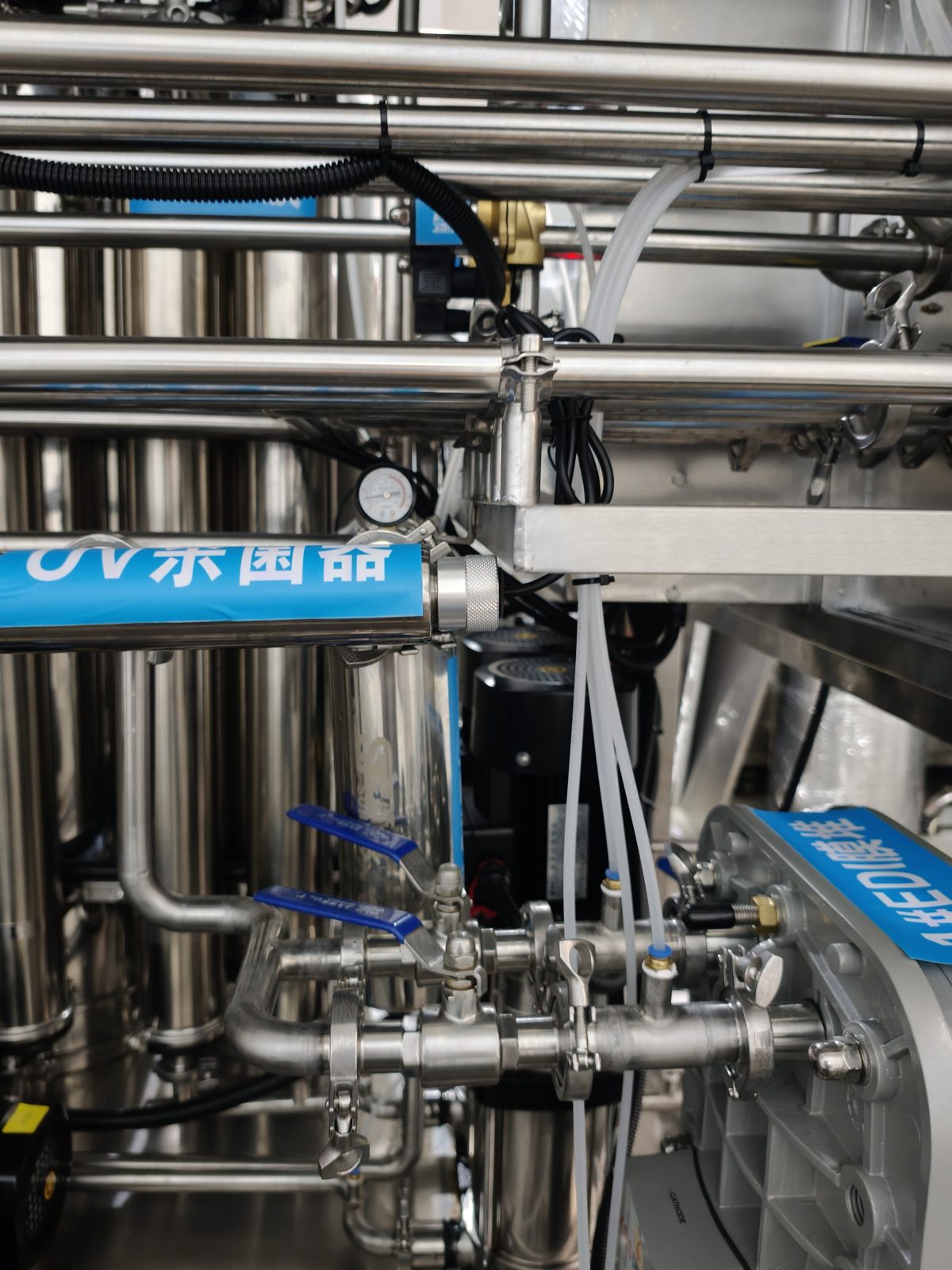
Two factors drive the choice:
- What purity ceiling does your spec actually need?
- How much do you value uptime, low OPEX and no chemical handling?
Everything else is detail.
The core comparison
| EDI | Mixed-bed polisher | |
|---|---|---|
| Regeneration | Electrical, continuous, in situ | Acid + caustic, batch, offline |
| Chemical consumption | None | High (HCl + NaOH) |
| Chemical waste | None — no neutralisation | Yes — must be neutralised and disposed |
| Operation | Continuous, unattended | Batch; downtime every 2–8 weeks for regeneration |
| Product resistivity | 15–18.2 MΩ·cm | 18.2 MΩ·cm (marginally higher ceiling) |
| O&M cost (typical) | ~60% lower than mixed bed | Baseline |
| Footprint | Smaller (no chemical tanks) | Larger (regeneration skid + acid/caustic storage) |
| Best duty | Continuous ultrapure demand | Final polishing guard / very top purity |
Two real consequences follow:
- EDI removes the chemical problem. No HCl and NaOH drums, no neutralisation pit, no hazardous-waste permit, no chance of a regeneration batch contaminating product. For a pharma line under GMP or a plant with no on-site chemical handling, this alone often decides it.
- A mixed bed is still the purity ceiling. When the spec is a rigid 18.2 MΩ·cm with zero tolerance (semiconductor UPW), the conventional winning design is EDI doing the bulk, a small polishing mixed bed downstream holding the final number.
When EDI is the right call
Choose EDI as your polishing stage when any of these apply:
- You want to eliminate acid and caustic from the plant (safety, permitting, staff exposure).
- Your ultrapure demand is continuous, and regeneration downtime on a mixed bed would hurt production.
- You value low OPEX — EDI typically runs 60% below a mixed bed over the lifecycle because there is no consumable chemical bill and no regenerant waste.
- You have tight footprint or site constraints — EDI needs no chemical storage or neutralisation area.
- You are in pharma or food where chemical handling near a product line is a contamination risk.
For most industrial, laboratory and pharmaceutical deionised-water duties in the 0.5–100 m³/h range, EDI is the answer we recommend first. Our DI-1000 is an RO + EDI unit delivering 10–15 MΩ·cm at 1 t/h — sized for industrial deionised water, lab supply and general process duty.
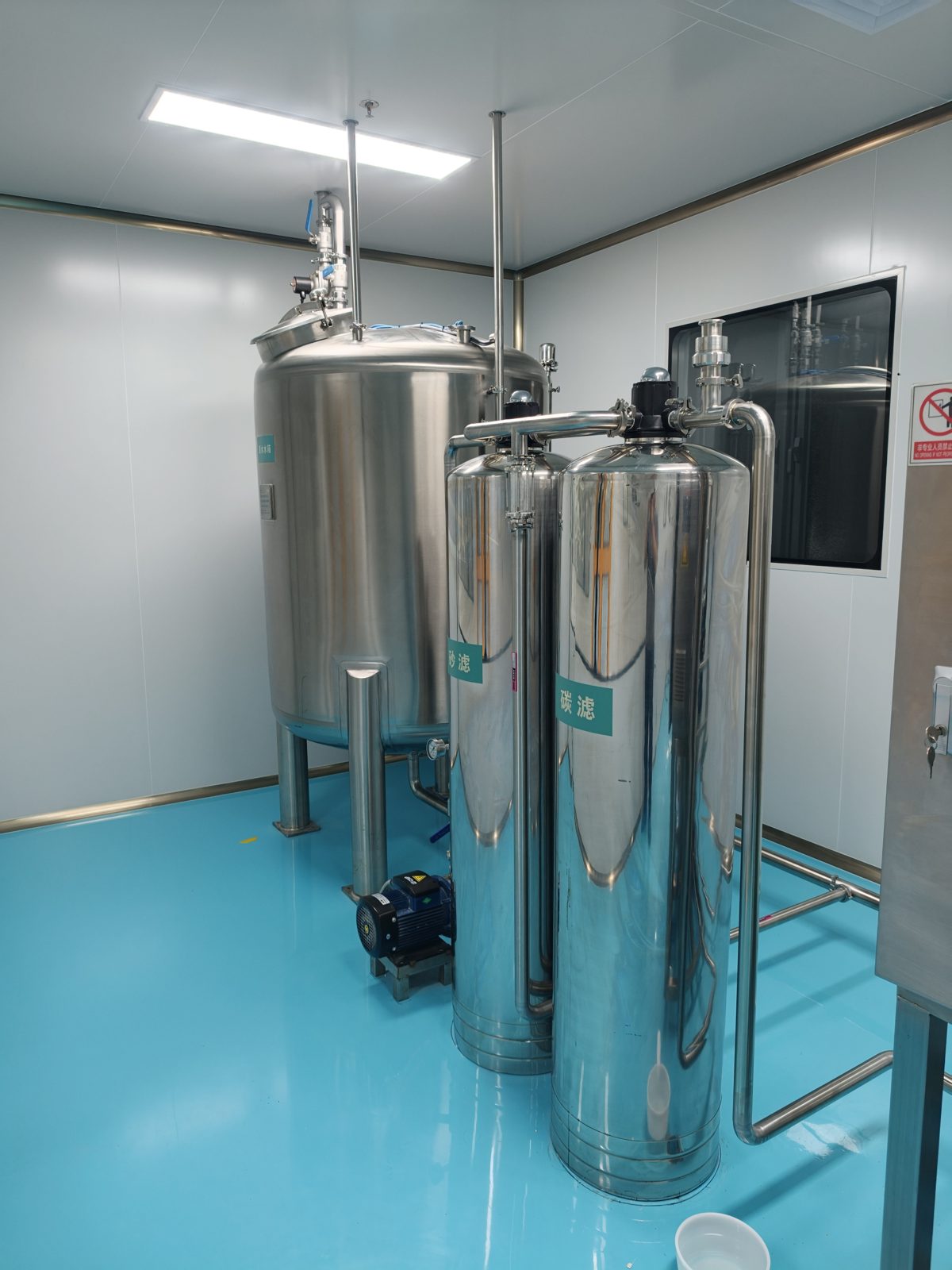
Where the requirement is the semiconductor-grade 18.2 MΩ·cm held continuously, EDI still leads; we engineer the EDI ultrapure line to order rather than sell it off the shelf.
When a mixed bed still wins
Before you drop the mixed bed entirely, two situations still call for it:
- The purity ceiling is 18.2 MΩ·cm with essentially no tolerance and you want a final polishing guard. EDI gets to ~15–18 MΩ·cm; a small polishing mixed bed after it holds 18.2 MΩ·cm when the load spikes.
- You already have acid/caustic and a regeneration skid from an older plant, and your duty is small or intermittent enough that the regeneration downtime does not matter.
The realistic modern architecture is a hybrid — and this is the one I’d build for a client today. EDI does the continuous bulk of the work; a small polishing mixed bed (regenerated infrequently) guards the final resistivity. You get EDI’s OPEX and reliability for 95% of the load, and the mixed bed’s purity ceiling for the 5% that demands it.
How the decision differs across semiconductor, pharma and power
The right answer depends on which industry you’re in — the three sectors weight uptime, purity ceiling and chemical handling very differently.
Semiconductor / electronics. The UPW spec is 18.2 MΩ·cm held continuously, and the line cannot stop — a regeneration batch mid-shift means lost wafers, not lost minutes. This is the classic EDI + small polishing mixed bed case: EDI carries the continuous load, the polishing bed guards the ceiling. For electronics & semiconductor buyers, running cost over 10 years is almost always decided by OPEX, not the initial skid price.
Pharmaceutical. Water for injection (WFI) and purified water under GMP add two constraints a mixed bed struggles with: the plant does not want acid/caustic anywhere near a product line, and every step must be continuously documented. EDI’s chemical-free, continuous, fully-instrumented operation is a natural fit. For pharmaceutical duty, the absence of chemical handling and the ease of validation often outweigh every other factor — which is why membrane-based (RO + EDI + UF) WFI is displacing older distillation-plus-mixed-bed trains.
Power & boiler feed. A high-pressure boiler’s feed limit is set by silica and sodium, not by achieving 18.2 MΩ·cm. Once conductivity and silica are low enough, a mixed bed adds purity the boiler cannot use, while its regeneration downtime and chemical bill add cost the plant does not want. For power and boiler feedwater make-up, EDI (or EDI following RO) delivers the required quality with high recovery and low OPEX.
Here’s the takeaway that applies in every sector: start from the purity ceiling your industry actually requires and your tolerance for downtime — then pick the cheapest technology that satisfies both. Increasingly that points to EDI doing the bulk of the work.
Don’t forget: EDI is picky about feed water
If I had to name the most common reason an EDI stack dies young, it’s feed water that wandered outside the spec. EDI is the most feed-sensitive piece of equipment in the whole train — exceed these limits and you damage the stack, often irreversibly:
| Parameter | EDI feed limit |
|---|---|
| Conductivity | ≤ 10 μS/cm (i.e. good RO permeate) |
| Hardness (as CaCO₃) | < 0.1 mg/L |
| Residual chlorine / oxidants | < 0.05 mg/L |
| SDI | < 1.0 |
| Temperature | 15–35 °C |
| pH | 5.5–8.5 |
If your RO is running well, these are met comfortably. If RO performance drifts, EDI is the first place you’ll see it. A 5 μm cartridge filter goes immediately upstream as the last barrier.
Mixed bed is slightly more forgiving on feed (it is designed to be regenerated and can absorb more), but a well-run RO is the right feeding arrangement for both.
Worked example — a 50 m³/h semiconductor UPW decision
Suppose you need 50 m³/h of ultrapure water at 17–18.2 MΩ·cm for a semiconductor or electronics line that runs 24/7 and cannot stop for regeneration.
| Design option | CAPEX | OPEX | Downtime | Notes |
|---|---|---|---|---|
| EDI only (say 3 × EDI skids, ~17–18 MΩ·cm) | $$$ | Lowest | None (continuous) | Usually meets 17–18 MΩ·cm; no chemicals |
| EDI + small polishing MB | $$$$ | Low | Minimal (MB rarely regenerates) | Holds rigid 18.2 MΩ·cm; the semiconductor gold standard |
| Mixed bed only | $$ | Highest (chemical bill) | Regeneration every few weeks | Simpler CAPEX, but OPEX + downtime bite over time |
For a line that cannot stop, EDI-only, or EDI + polishing MB, is almost always the right answer. The “cheaper” mixed-bed-only option pays its lower CAPEX back in higher chemical OPEX and forced regeneration downtime within the first couple of years.
The RO stage feeding this train is where the quality story starts — a well-sized single-pass RO at 2–10 μS/cm is the precondition for EDI to work. For the arithmetic that gets you there, see How to Size an Industrial RO System; the RO-4000 series is the brackish-water workhorse we size for this envelope.
The mistakes that kill an EDI stack (and how to avoid them)
- Energising without water. Dry-running burns the resin and can destroy the membrane stack. Water first, then power — always interlock them.
- Letting oxidants through. Residual chlorine above 0.05 mg/L causes permanent oxidative poisoning. This damage does not wash out.
- Letting hardness or particulates through. They scale and block the flow channels, damaging the stack mechanically.
All three are preventable with instrumentation and interlocks — the same discipline that keeps a good RO alive. If you are choosing between vendors, ask how the EDI system is protected; the answer tells you a lot about how long it will last.
A 5-question checklist before you commit
Run any EDI or mixed-bed proposal through these five questions before you sign:
- What is the feed hardness and CO₂ load? Both decide whether EDI can reach your resistivity target without a softener or degasser upstream.
- What does regeneration really cost? Ask for delivered acid and caustic prices, waste neutralisation and labour — not just resin volume.
- What happens during regeneration or stack cleaning? If your line cannot tolerate an interruption, you need redundancy or a buffer tank, and it should appear in the quote.
- Is the silica spec contractual? Make the vendor guarantee resistivity and silica at the point of use, not at the skid.
- Who carries the consumables? Electrode spares, monitoring probes and, for mixed beds, resin supply — a local stock answer beats a six-week sea freight.
A vendor who answers all five with numbers instead of adjectives is usually a vendor worth shortlisting.
FAQ
What does EDI remove that RO does not?
RO removes 98%+ of dissolved salts, leaving ~2–10 μS/cm permeate. EDI polishes that remaining trace ionic load up to 15–18.2 MΩ·cm, continuously and without chemicals.
Does EDI use chemicals?
No. Regeneration is electrochemical — the DC field splits water into H⁺ and OH⁻ to regenerate the resin. No acid, no caustic, no neutralisation.
Is a mixed bed more pure than EDI?
Marginally at the very top — a mixed bed holds a slightly steadier 18.2 MΩ·cm. That is why a small polishing mixed bed sometimes sits behind EDI in semiconductor UPW. For everything short of that ceiling, EDI’s purity is equal and its OPEX is far lower.
Can EDI replace a mixed bed entirely?
For most duties, yes — that is its main purpose. For rigid semiconductor-grade 18.2 MΩ·cm, the standard is EDI plus a small downstream polishing bed.
Which has lower running cost?
EDI, typically ~60% lower — no consumable acid/caustic, no regenerant waste disposal, no regeneration downtime. The lower CAPEX of a mixed bed is eaten by higher OPEX within a few years.
What feed water does EDI need?
Conductivity ≤ 10 μS/cm, hardness < 0.1 mg/L as CaCO₃, residual chlorine < 0.05 mg/L, SDI < 1.0, temperature 15–35 °C, pH 5.5–8.5. These are hard limits, not targets.
Need help choosing between EDI and a mixed bed?
Send us your RO permeate analysis and your target resistivity, and tell us whether your line can tolerate regeneration downtime. We will tell you whether EDI alone, a mixed bed, or the hybrid gets you there — and size it accordingly.
Get a free system assessment →
Or message an engineer on WhatsApp — we reply within 12 hours (GMT+8 working hours).
About the author: Ella Liu — Industrial Water Treatment Specialist at Rong Water (a brand of Shenzhen Qiukanghong Technology Co., Ltd., est. 2012). She has sized EDI, mixed-bed and hybrid ultrapure trains for clients across Southeast Asia, the Middle East, Africa and South America. Connect on LinkedIn or email [email protected].