Power Plant Boiler Feedwater & Make-Up Water Systems — RO + EDI / Mixed Bed for Utility Boilers
Two-pass RO → EDI or mixed-bed → condensate polishing, engineered for high-pressure and supercritical utility boilers (≥ 9.8 MPa) where silica and iron at the ppb level decide scale, turbine life and unit availability. Capacities from 10 t/h package units to 100+ t/h multi-train make-up water plants.
Request a Feedwater Sizing Sheet Talk to a power plant water engineer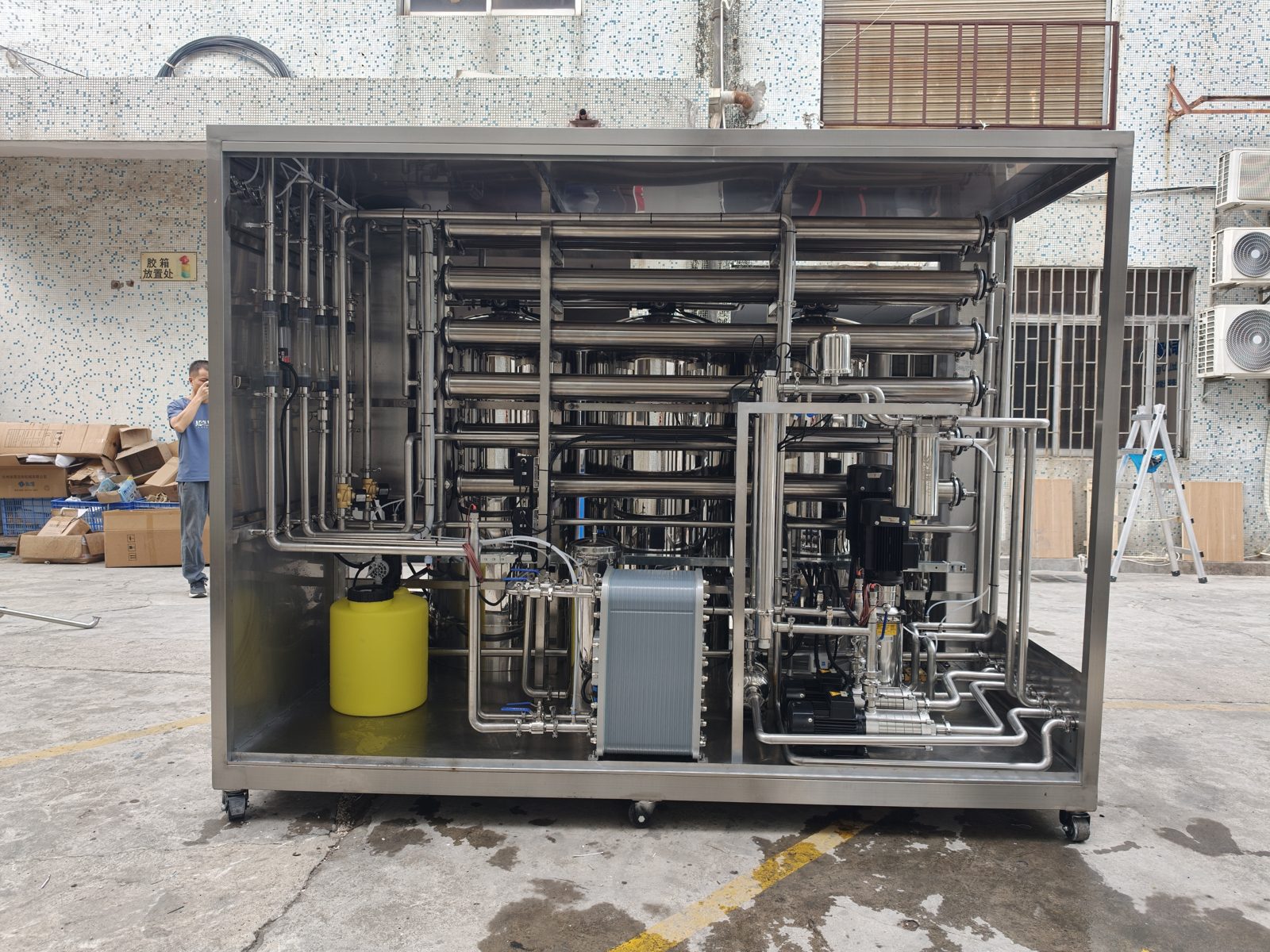
Why Make-Up Water Quality Sets Your Boiler's Life
On a high-pressure or supercritical utility boiler, the feedwater is the bloodstream of the unit. Silica above the ppb limit deposits on turbine blades and is essentially irreversible in service; iron carries into the boiler and fouls heat-transfer surfaces; hardness or oxygen at the wrong point causes tube failures and forced outages. We design make-up and polishing trains to GB/T 12145, ASME and VGB feedwater guidelines, holding silica and iron at the ppb level the turbine manufacturer specifies — not just meeting a generic limit.
| What you control | Why it matters | Target we hold |
|---|---|---|
| Silica (SiO₂) | Turbine blade deposits | < 20 ppb (HP), < 10 ppb (supercritical) |
| Iron (Fe) | Boiler tube fouling | < 20 ppb at economiser inlet |
| Conductivity (cation) | Total ionic load on boiler | < 0.2 µS/cm (make-up), < 0.15 µS/cm (after polishing) |
| Sodium (Na) | Stress-corrosion on turbines | < 5 ppb |
| pH (at ammonia/morpholine) | Corrosion control in feed train | 8.8–9.3 (all-volatile treatment) |
Our Standard Make-Up Water Trains
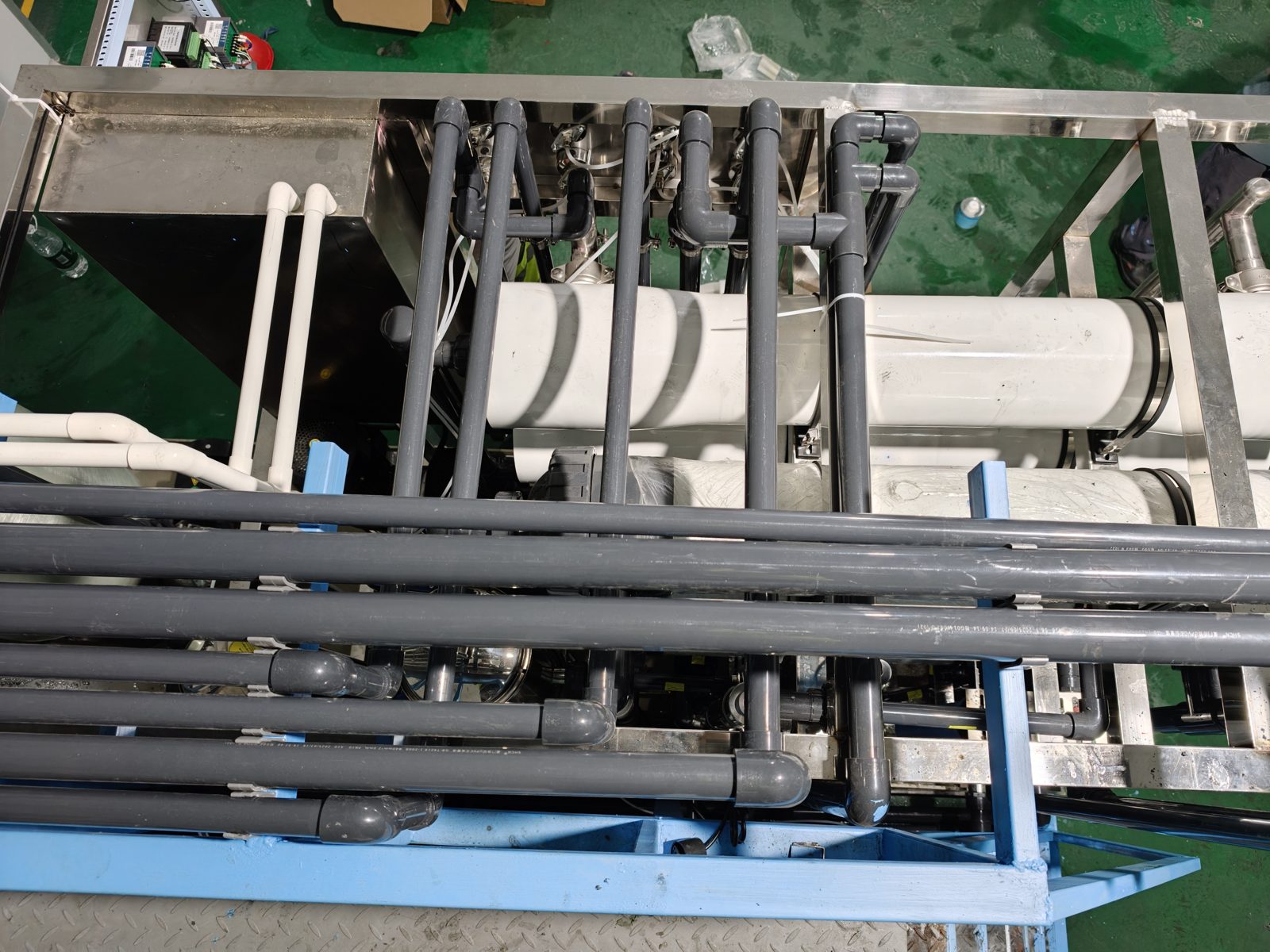
Two standard trains dominate utility make-up: RO + EDI (no acid/caustic, preferred) and RO + mixed-bed (higher purity margin, needs regen). We recommend based on boiler pressure, capacity and chemical-handling preference.
| Train | Best for | Stages | Final water |
|---|---|---|---|
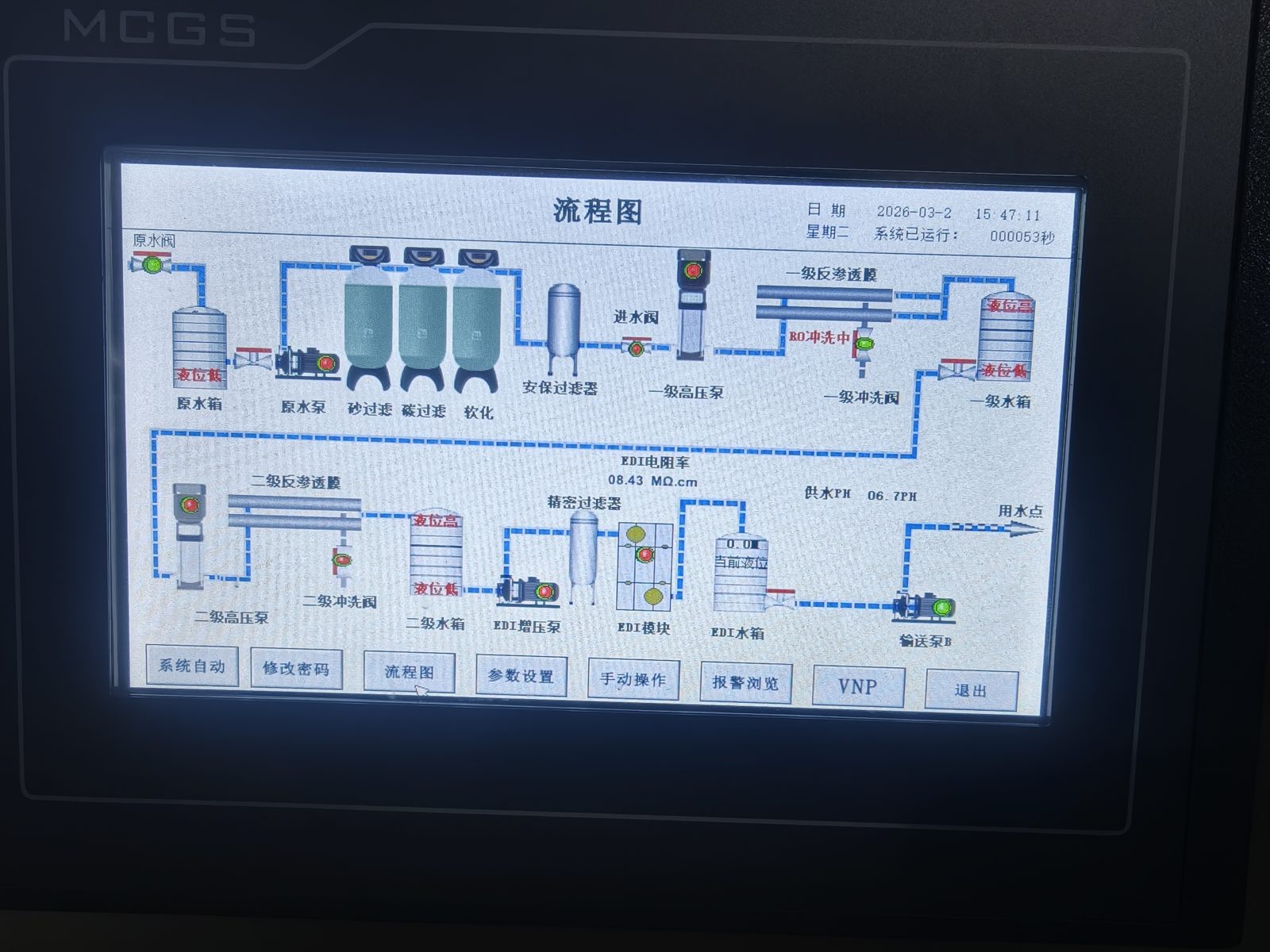
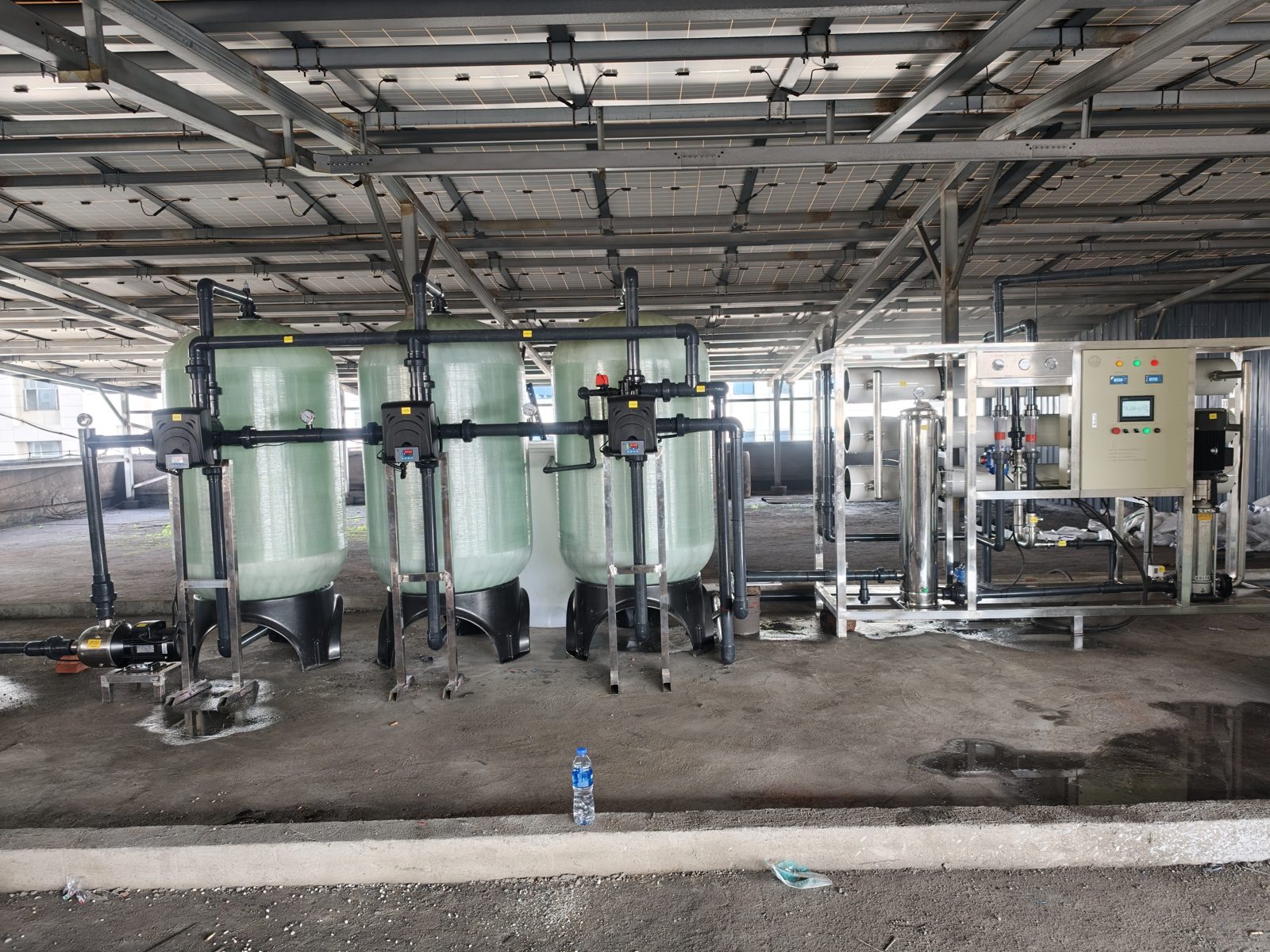
| P1 — RO + EDI | Most HP / subcritical units, no-regen preference | UF/pretreat → two-pass RO → EDI → degasser → make-up | < 0.2 µS/cm, SiO₂ < 20 ppb |
| P2 — RO + mixed-bed | Supercritical / once-through units | Two-pass RO → MB polisher → make-up | < 0.1 µS/cm, SiO₂ < 10 ppb |
| P3 — Condensate polishing | Separate condensate return | Pre-filter → deep-bed or mixed-bed polisher | Restores feed quality on return |
Make-up trains are sized for normal load plus start-up/emergency demand (typically 1.3–1.5×), and are N+1 configured so one train can be regenerated or maintained without dropping plant output.
Materials We Use
| Component | Material | Why |
|---|---|---|
| RO vessels | FRP with vinyl ester liner | Corrosion-free in high-salinity service |
| High-pressure piping | SS 316L / lined carbon steel | Handles RO concentrate pressure |
| Make-up tanks | Carbon steel with internal lining / SS | N₂-blanketed to prevent O₂ ingress |
| EDI stacks | Veolia / Suez / QKH-EDI | Continuous, no acid/caustic regen |
| Resin (MB) | Nuclear / high-purity grade | SiO₂ and Na removal to ppb |
Standard Capacities (Make-Up Water)
| Model | Output | Power | Typical unit |
|---|---|---|---|
| MU-10 | 10 t/h | 35 kW | Small CHP / industrial IPP |
| MU-20 | 20 t/h | 70 kW | 50–100 MW subcritical |
| MU-50 | 50 t/h | 170 kW | 200–300 MW unit |
| MU-100 | 100 t/h | 330 kW | 600 MW–1 GW utility |
| MU-100+ | Custom multi-train | Custom | Plant-wide / N+1 |
Skids pre-piped, pre-wired, FAT-tested. On-site installation aligned to your outage / commissioning window.
Engineering Reference — 50 t/h Make-Up for a 300 MW Subcritical Unit
| Parameter | Design value |
|---|---|
| Feed | Municipal / surface, TDS ≈ 300 ppm, SiO₂ ≈ 15 ppm |
| Make-up demand | 50 t/h (normal), 70 t/h peak with start-up |
| Final water | < 0.2 µS/cm, SiO₂ < 20 ppb, Fe < 20 ppb |
| Train | Clarifier/UF → two-pass RO → EDI (2×25 t/h, N+1) → degasser |
| Storage | Make-up tank, N₂-blanketed, degassed to O₂ < 5 ppb |
| Controls | Siemens S7 / DCS handover, online SiO₂ + conductivity + ORP |
| Delivery | 18–24 weeks from PO |
5 Pitfalls We Design Around
- Silica slip past EDI at high recovery — two-pass RO drops silica before EDI; online SiO₂ on EDI outlet with auto-divert.
- O₂ ingress into make-up — N₂ blanket + degasser; O₂ monitoring at tank outlet.
- Feed TDS swings with season — RO sized to worst-case feed; blending/trim valve on conductivity.
- Regen downtime on a single-train MB — N+1 design so polishing never interrupts make-up supply.
- Condensate contamination from a leaking condenser — conductivity-based auto-dump on condensate polisher inlet.
Standards We Design To
- GB/T 12145 — Quality of water/steam for generating plant
- ASME — Feedwater & boiler water quality guidelines
- VGB-S-010-T-00 — Make-up water for utility boilers
- GB/T 1576 — (for industrial boilers, see our Boiler page)
- ISO 9001 / ISO 14001 / ISO 45001
Frequently Asked Questions
Q1. EDI or mixed-bed for my make-up water?
For most subcritical HP units, RO + EDI holds < 0.2 µS/cm and < 20 ppb silica with no acid/caustic handling. Supercritical/once-through units needing < 0.1 µS/cm and < 10 ppb silica usually keep a mixed-bed polisher. We size to your boiler pressure and turbine maker's spec.
Q2. Can you handle silica at the ppb level reliably?
Yes — two-pass RO ahead of EDI/MB drops silica to well under feed; online SiO₂ analysers verify < 20 ppb at the outlet during OQ and normal operation.
Q3. How do you size for start-up demand?
Make-up is sized for normal load plus a 1.3–1.5× start-up factor, with an N+1 train so regeneration or maintenance never drops plant output.
Q4. Do you supply condensate polishing?
Yes — separate deep-bed or mixed-bed condensate polishers with conductivity-based auto-dump to protect the feed train from a condenser leak.
Q5. What controls and integration do you provide?
Siemens or DCS handover with online SiO₂, cation conductivity, ORP and flow. We integrate to your plant DCS via Profibus/Profinet or OPC.
Q6. What is the warranty?
12 months on the complete system plus 36 months on critical parts (RO membranes, EDI stacks, UV lamps). On-site labour and travel included in the first 12 months.
Q7. Do you provide commissioning during an outage window?
Yes — we align FAT and on-site commissioning to your planned outage, with staged handover so the unit can return to service on schedule.
Q8. What is the difference from your industrial boiler page?
This page is utility-scale (≥ 9.8 MPa, ≥ 10 t/h, N+1 make-up). For medium/low-pressure industrial boilers (0.8–3.8 MPa) see our Boiler & Steam page.
Related Equipment & Industries
RO-4000 — Reverse Osmosis · DI-1000 — Deionized Water · UF-2000 — Ultrafiltration · WR-3000 — Water Reuse (cooling blowdown recovery)
Boiler & Steam (Industrial) · Seawater Desalination · Pharmaceutical & Biotech
Ready to Spec Your Make-Up Water System?
Get a free make-up water sizing sheet + GB/T 12145 checklist within 24 h.
Request a Feedwater Sizing Sheet Talk to a power water engineerTechnical content reviewed by Ella Liu, Industrial Water Treatment Specialist at Rong Water — 10+ years sizing RO, EDI and mixed-bed feedwater systems for utility power clients.