Laboratory Water Purification Systems — ASTM D1193 Type I–III & ISO 3696 Grade 1–3, 10 L/h to 2,000 L/h
Point-of-use purifiers and central laboratory loops engineered to the grade your instruments actually need — Type I for HPLC, ICP-MS and cell culture, Type II for reagent make-up and microbiology, Type III for glassware washers and autoclave feed. RO → EDI → 254 nm UV → 0.22 µm point-of-use polish, with terminal ultrafiltration where endotoxin control is required.
Request a Lab Water Grade Map Talk to a lab water specialist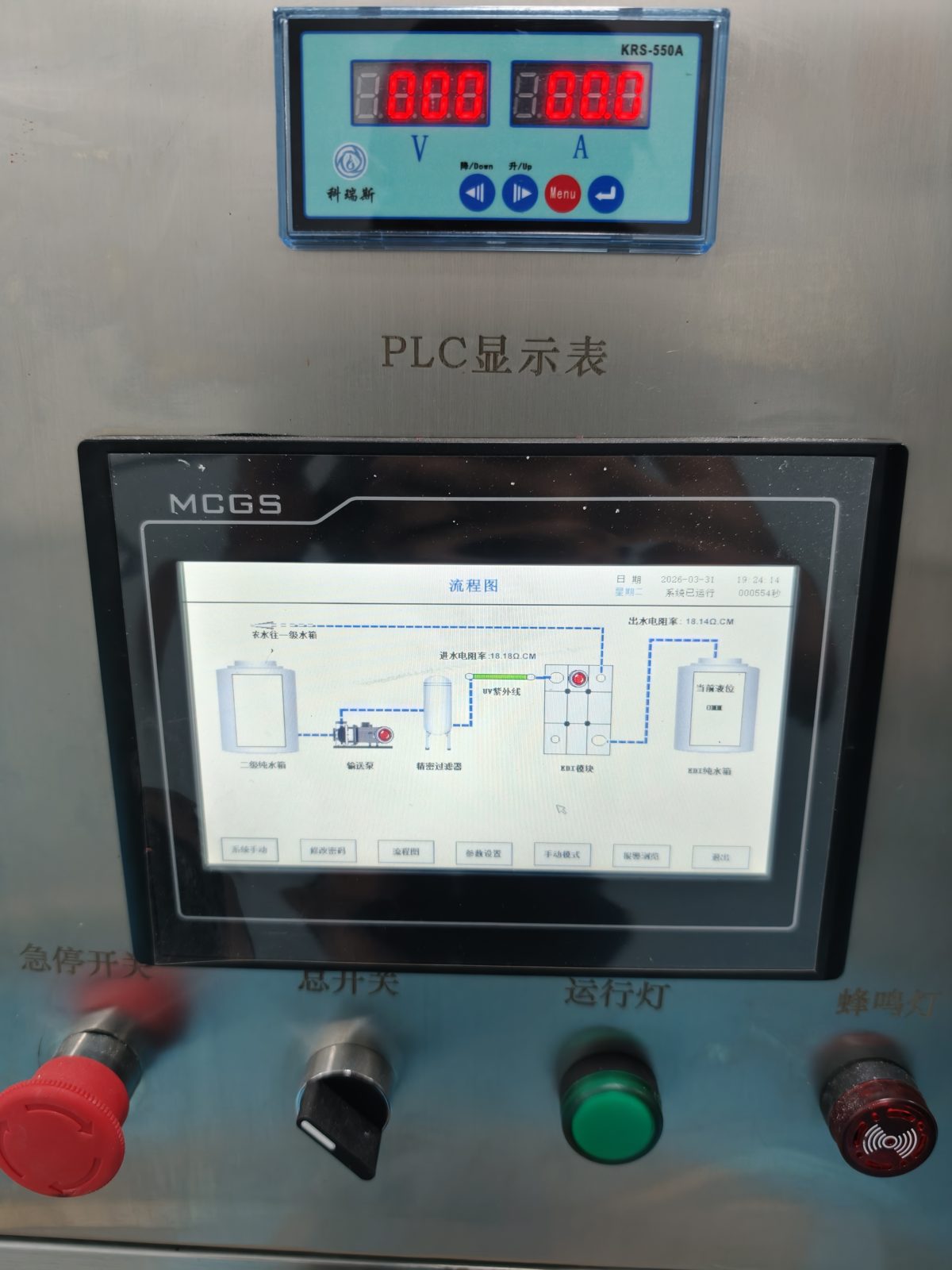
Why Lab Water Is Bought by Grade, Not by Flow Rate
Almost every lab water quote we are asked to beat is compared on litres per hour. That is the wrong axis. An ICP-MS will not care that your purifier makes 60 L/h if the TOC is drifting; a cell culture lab will lose a week of work to bacteria long before it runs out of water. The right question is which grade each instrument needs, then how much peak flow those instruments draw together. We map that before quoting a single skid.
| Grade | Typical use | Target we hold |
|---|---|---|
| Type I (ASTM D1193) | HPLC, ICP-MS / ICP-OES, GC-MS, cell culture, molecular biology | 18.2 MΩ·cm @ 25 °C, TOC < 10 ppb, bacteria < 1 CFU/mL |
| Type II | Reagent make-up, microbiology media, general chemistry, feed to Type I | > 1 MΩ·cm, TOC < 50 ppb, bacteria < 100 CFU/mL |
| Type III | Glassware rinsing, autoclave / washer feed, humidifier feed | > 4 MΩ·cm, TOC < 200 ppb |
| CLRW (clinical, CLSI GP40) | Clinical chemistry, immunoassay analysers | ≥ 10 MΩ·cm, bacteria < 10 CFU/mL, endotoxin controlled by terminal UF |
| Endotoxin-sensitive | Cell culture, pyrogen-sensitive work | Terminal 10 kDa UF; validated against your lab's own limit |
| Peak flow | Glassware washer + several taps simultaneously | Sized on simultaneous draw, not average |
Our Standard Purification Train for Laboratories
| Stage | Equipment | Function | Key spec |
|---|---|---|---|
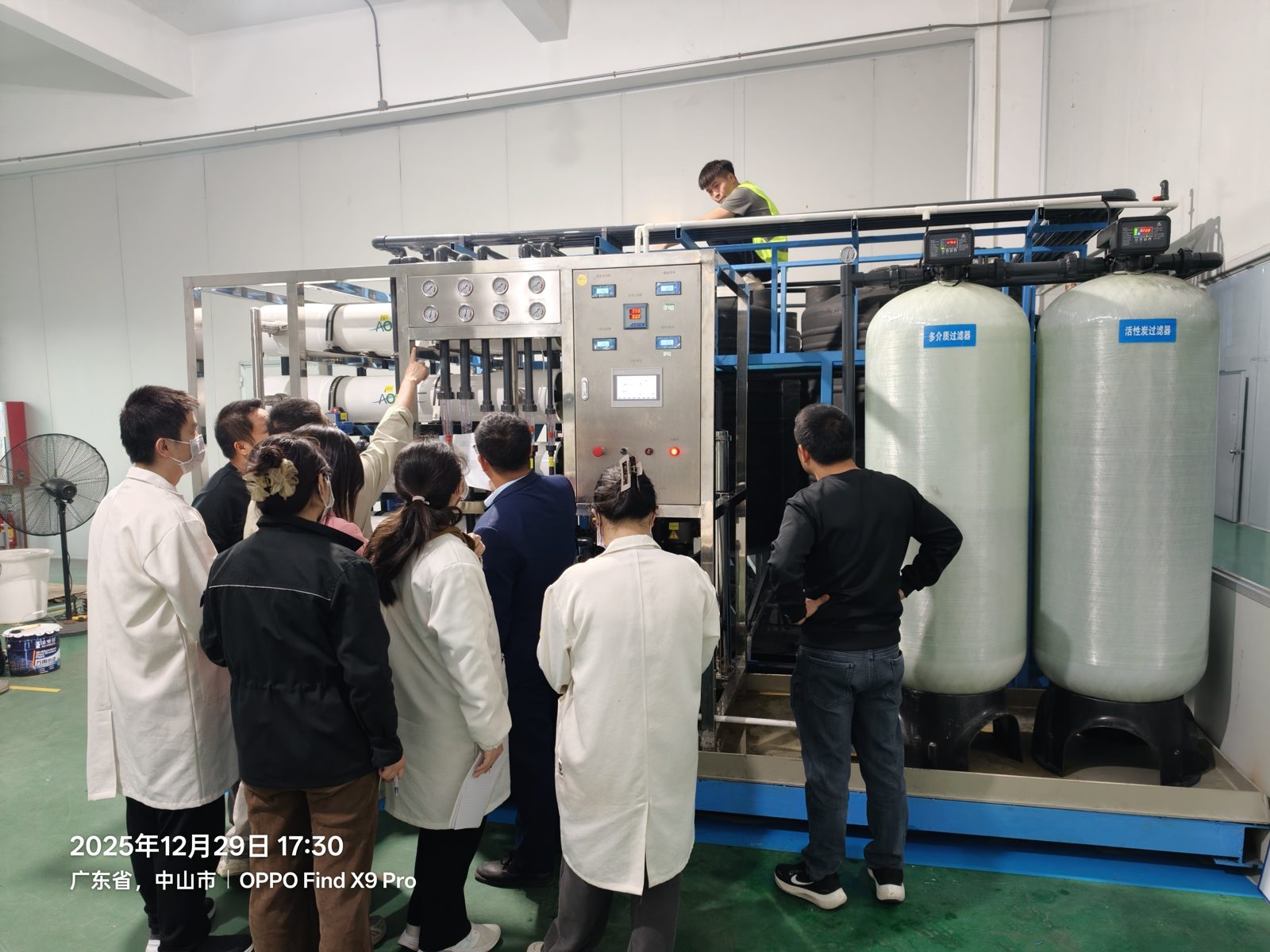
| ① Pretreatment | 5 µm sediment + activated carbon + softener (or antiscalant) | Protect RO from chlorine, hardness, particles | Free Cl₂ < 0.1 ppm, SDI < 5 |
| ② RO | Compact RO module (e.g. RO-250 class) | Bulk demineralisation, 95–99% rejection | Permeate < 20 µS/cm |
| ③ Deionisation | EDI or exchangeable DI cylinders | Polish to > 15 MΩ·cm | EDI: continuous; cylinders: scheduled exchange |
| ④ Bacteria control | 254 nm UV + recirculation | Suppress biofilm in storage and loop | Dose ≥ 30 mJ/cm² |
| ⑤ TOC reduction | 185 nm UV (on Type I systems) | Oxidise trace organics | TOC < 10 ppb at point-of-use |
| ⑥ Polishing | Nuclear-grade mixed-bed cartridge | Final ionic polish to 18.2 MΩ·cm | Replace on resistivity or timer |
| ⑦ Terminal filtration | 0.22 µm capsule / 10 kDa UF | Bacteria and endotoxin removal at the tap | Bacteria < 1 CFU/mL |
| ⑧ Distribution | PVDF or electropolished SS316L loop | Deliver without recontamination | 1.5–2 m/s, zero dead legs |
| ⑨ Sanitisation | Chemical or hot-water / ozone cycle | Periodic biofilm control | Quarterly or per your SOP |
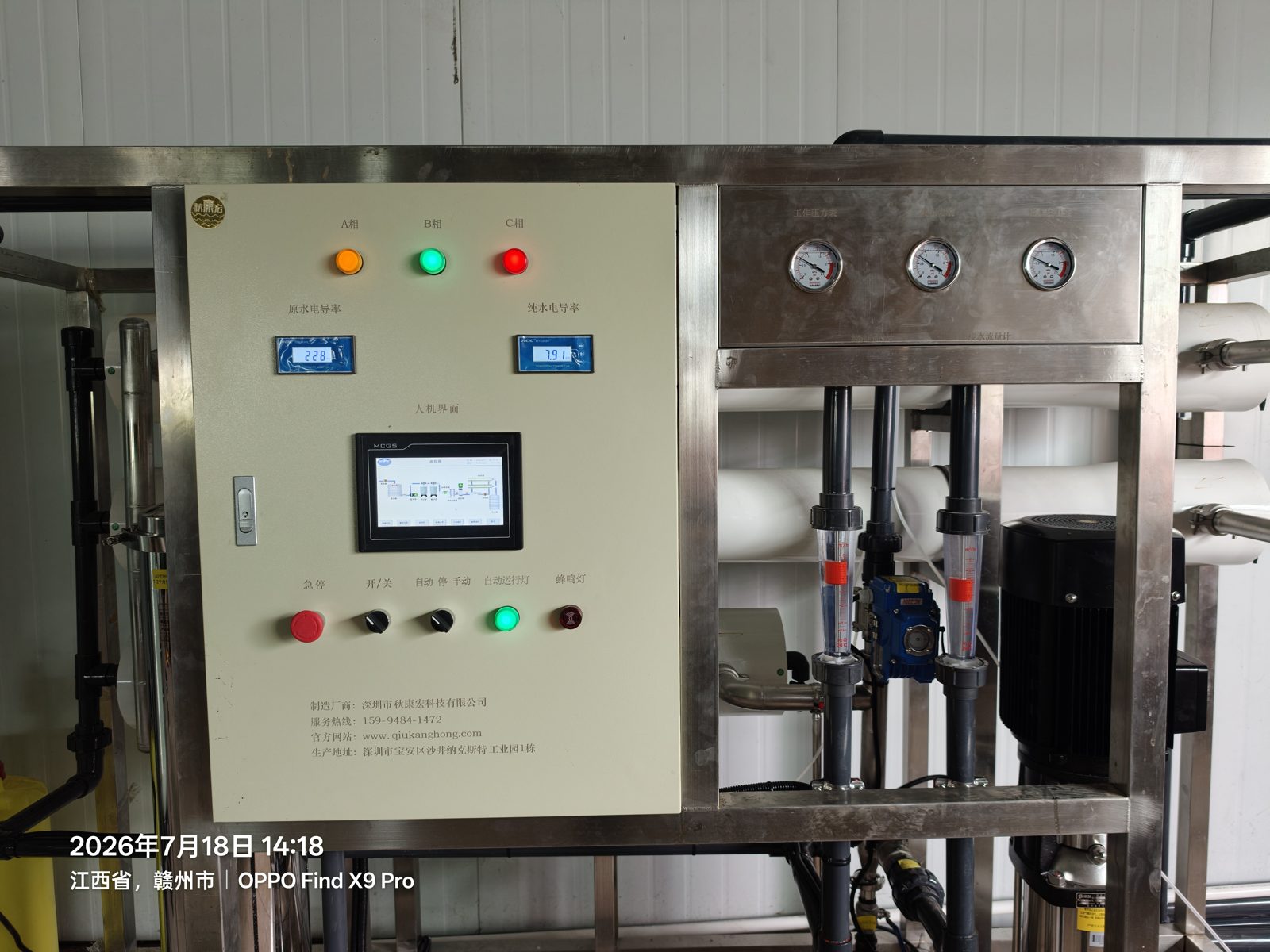
| ⑩ Monitoring | Online resistivity + TOC + flow | Evidence for accreditation | Data log exportable to LIMS |
Small labs with a single instrument room usually stop at ⑦ with a point-of-use unit. Multi-floor QC labs and hospitals need ⑧–⑩, and that is where most "cheap" systems fail their first audit.
Materials We Use (Leachables Matter Here)
| Wetted part | Material | Why it is chosen |
|---|---|---|
| Distribution loop | PVDF or electropolished SS316L | Lowest extractables, sanitisation-tolerant |
| Final run to the tap | PFA or PVDF | No plasticiser leaching into Type I water |
| Storage tank | HDPE or PVDF-lined, vent-filtered | No metal contact, bacteria-tight vent |
| Valves | Diaphragm (PTFE / EPDM) or PVDF | No dead legs, serviceable in place |
| Point-of-use housing | Medical-grade PP / PVDF | Clean replacement without tools |
| UF module | 10 kDa polysulfone / PES hollow fibre | Endotoxin and nuclease retention |
Material and extractables documentation ships with every system — useful evidence when your accreditation body asks why the loop is PVDF and not PVC.
Standard Capacities (Laboratory & Analytical)
| Model | Output | Power | Typical application |
|---|---|---|---|
| LB-10 | 10 L/h | 0.3 kW | Single instrument bench, HPLC |
| LB-30 | 30 L/h | 0.5 kW | Small QC room, 3–5 benches |
| LB-60 | 60 L/h | 0.9 kW | Analytical lab + glassware washer |
| LB-120 | 120 L/h | 1.6 kW | One-floor loop, mixed Type I / II draws |
| LB-250 | 250 L/h | 3.2 kW | Multi-floor QC or hospital lab |
| LB-500 / LB-1000+ | 500–2,000 L/h | 6–18 kW | Central ring main, campus or hospital |
Point-of-use units ship pre-assembled and are typically running the same day. Central loops include loop design, installation and a documented sanitisation and monitoring SOP.
Engineering Reference — 120 L/h Loop for a Three-Floor QC Laboratory
| Parameter | Design value |
|---|---|
| Feed | City water, TDS ≈ 220 ppm, free Cl₂ < 0.5 ppm, hardness ≈ 2.1 mmol/L |
| Type I demand | 40 L/h continuous, 2× peak for 15 min |
| Type II demand | 60 L/h (media prep, reagent make-up) |
| Type III demand | 20 L/h (glassware washer, autoclave feed) |
| Product quality | 18.2 MΩ·cm at point-of-use, TOC < 10 ppb, bacteria < 1 CFU/mL |
| Loop | PVDF ring main, 1.8 m/s, 3× tank turnover/h, zero dead legs |
| Storage | 300 L PVDF-lined tank, vent filter, 254 nm UV on return |
| Monitoring | Online resistivity + TOC, logged to LIMS over Modbus TCP |
| Sanitisation | Chemical cycle quarterly, ozone on request |
| Delivery | 6–8 weeks from PO |
5 Pitfalls We Design Around
- Buying on 18.2 MΩ·cm alone — resistivity says nothing about TOC, bacteria or nucleases. We specify all four together and log the two that drift (TOC and bacteria).
- Bacteria rebound in the storage tank — a tank without UV on the return and a vent filter becomes a biofilm reactor. We size 254 nm UV on the return and specify the sanitisation interval in the SOP.
- PVC or wrong-plastic extractables — cheap tubing leaches plasticisers into Type I water and shows up as ghost peaks. We use PVDF or electropolished SS316L on the loop and PFA on the final drop.
- Undersized peak draw — a glassware washer pulling 20 L/min collapses loop pressure and everyone's resistivity dips. We size on simultaneous demand, not on average consumption.
- No sanitisation routine — every loop needs a documented cycle (chemical, hot water or ozone) and a replacement schedule for final filters. We hand over the schedule, not just the machine.
Standards We Design To
- ASTM D1193 — Standard specification for reagent water (Type I–IV)
- ISO 3696 — Water for analytical laboratory use (Grade 1–3)
- CLSI GP40 — Preparation and testing of reagent water in the clinical laboratory (CLRW)
- CAP / ISO 15189 checklist requirements for clinical laboratory water (documentation support)
- ISO 9001 / ISO 14001 / ISO 45001 certified factory; CE / IEC 61010 for instrumentation
- EN 10204 3.1 material certificates on loop and tank wetted parts
Frequently Asked Questions
Q1. Which grade does each of our instruments need?
Rule of thumb: Type I for HPLC, ICP-MS, GC-MS, cell and molecular biology; Type II for reagent make-up, media and microbiology; Type III for glassware washers and autoclaves. Send us your instrument list and we will return a grade-by-grade map with the peak flow for each.
Q2. EDI or replaceable DI cylinders?
Cylinders are cheaper to buy and fine for a single bench that uses under about 30 L/h. EDI is continuous, needs no cylinder exchange and no waste resin handling, and is the better choice once you cross roughly 60 L/h or run a loop.
Q3. Do we need a distribution loop, or will point-of-use units do?
Point-of-use units win below about 60 L/h and when instruments sit in one room. Once draws are spread over more than one floor, or you need documented monitoring for accreditation, a PVDF loop with online resistivity and TOC is the defensible design.
Q4. How do you control bacteria long term?
Three things together: 254 nm UV on the tank return, continuous recirculation at 1.5–2 m/s with no dead legs, and a documented sanitisation cycle (chemical, hot water or ozone) plus scheduled final-filter replacement.
Q5. Can you meet endotoxin requirements for cell culture or clinical work?
Yes — terminal 10 kDa ultrafiltration at the point of use removes endotoxin and nucleases. We size the UF module to your validated limit and provide retention data with the unit.
Q6. What monitoring and documentation do we get?
Online resistivity and TOC with data logging, Modbus TCP export to your LIMS, a full O&M manual, EN 10204 3.1 material certificates, and a commissioning report with IQ/OQ templates suitable for ISO 15189 or GMP-adjacent audits.
Q7. What feed water do you accept?
Potable city water, TDS up to about 500 ppm, free chlorine under 1 ppm. Hard water gets a softener or antiscalant ahead of the RO; very hard or high-silica well water may need pretreatment designed case by case.
Q8. What is the warranty and consumables position?
12 months on the complete system plus 36 months on critical parts (RO membrane, EDI stack, UV lamps). We ship a 2-year consumables forecast with every system, so filter and lamp changes are budgeted rather than emergency purchases.
Related Equipment & Industries
DI-100 — Deionized Water (100 L/h) · RO-250 — Compact RO (0.25 t/h) · PW-250 — Compact Purified Water (250 L/h) · UF-2000 — Ultrafiltration
Pharmaceutical & Biotech (GMP) · Semiconductor & Electronics (UPW) · Food & Beverage (process water)
Ready to Specify Your Lab Water Grades?
Send your instrument list — we return a free grade map (which bench needs Type I, II or III) with peak-flow sizing within 24 h.
Request a Lab Water Grade Map Talk to a lab water specialistTechnical content reviewed by Ella Liu, Industrial Water Treatment Specialist at Rong Water — 10+ years specifying Type I–III and clinical reagent water systems for QC, analytical and hospital laboratories.