RO Membrane CIP: When to Clean, When to Replace, and How Much It Costs
By Ella Liu — Industrial Water Treatment Specialist at Rong Water. 10+ years sizing RO, UF, deionised, EDI ultrapure and GMP purified water systems.
Two plants I visited last year had the same story. Both ran brackish RO at ~80 m³/h. Both replaced their membranes at year three. Both could have run another two, maybe three years if the cleaning had been done right.
The thing is, the cleaning was being done — every quarter, on schedule. It just wasn’t being matched to the fouling. Generic alkaline wash on a calcium-scaling feed, acid wash on a biofouled membrane, the same recipe every time. The membrane didn’t fail from old age. It failed from chemistry that consolidated the fouling instead of removing it.
This article walks the decision tree for clean vs replace, the chemistry that actually works for each fouling type, and a worked cost comparison showing when cleaning pays versus when replacement is the only honest answer. If you have not sized the RO system in the first place, read How to Size an Industrial RO System: The 6 Inputs Every Spec Must Include first — this article assumes you already have a working system that is underperforming.
Why generic cleaning wastes membranes
A typical RO plant runs the same CIP recipe every quarter — alkaline surfactant at pH 12, sometimes a follow-up acid wash. Sometimes it works. Often it does nothing, and the plant replaces the membrane at year three when it could have run to year seven.
Generic cleaning fails because fouling isn’t one thing. There are at least four fundamentally different mechanisms, and the chemistry that destroys one consolidates another. Alkaline cleaning applied to a scaling-fouled membrane converts calcium carbonate to calcium hydroxide and drives the foulant deeper into the membrane. Acid cleaning applied to an organic-biofouled membrane does nothing and wastes a shutdown.
So: diagnose first, then pick the chemistry. The diagnosis is cheaper than a wrong cleaning.
The four fouling families and the chemistry that works
| Fouling type | What it looks like | Cause | Cleaning chemistry |
|---|---|---|---|
| Scaling (CaCO₃, CaSO₄, SiO₂) | Permeate flow drops sharply, feed pressure rises, salt passage slowly increases | Concentration of sparingly soluble salts past solubility limit | Acid: 0.2–0.5% HCl or 2% citric acid, pH 2–4, 35 °C, 2–4 h circulation |
| Organic / biological | Differential pressure rises first, then permeate flow drops, salt passage stable | Bacteria, humic/fulvic acids, biofilm | Alkaline + oxidant: 0.1% NaOH + 0.1% Na₄EDTA at pH 11–12, 30 °C, 2 h; or 200–500 ppm NaOCl at pH 10–11 |
| Colloidal / silt | TMP rises steadily across stages, all parameters drift together | Clay, iron, aluminium hydroxide, silica fines | High-pH surfactant: 0.1% NaOH + 0.5% SDS or proprietary surfactant, 35 °C, 1–2 h; followed by acid to remove the inorganic binder |
| Oxidative damage | Salt passage jumps suddenly, permeate flow may even rise at first | Free chlorine, ozone, permanganate breakthrough | No cleaning fixes this. Replace the element and fix the dechlorination upstream |
The mistake is to run alkaline chemistry against a scale-fouled membrane and acid against a biofouled one. The first converts the scale to a denser precipitate; the second wastes the shutdown.
Here’s the bit vendors don’t tell you when they sell you the CIP skid: temperature matters far more than concentration. Most recipes quote “30–35 °C”, but cleaning at 20 °C instead of 35 °C typically halves the removal rate. On a cold site, add a heater to the CIP skid; the capital pays back in the first cleaning that actually works.
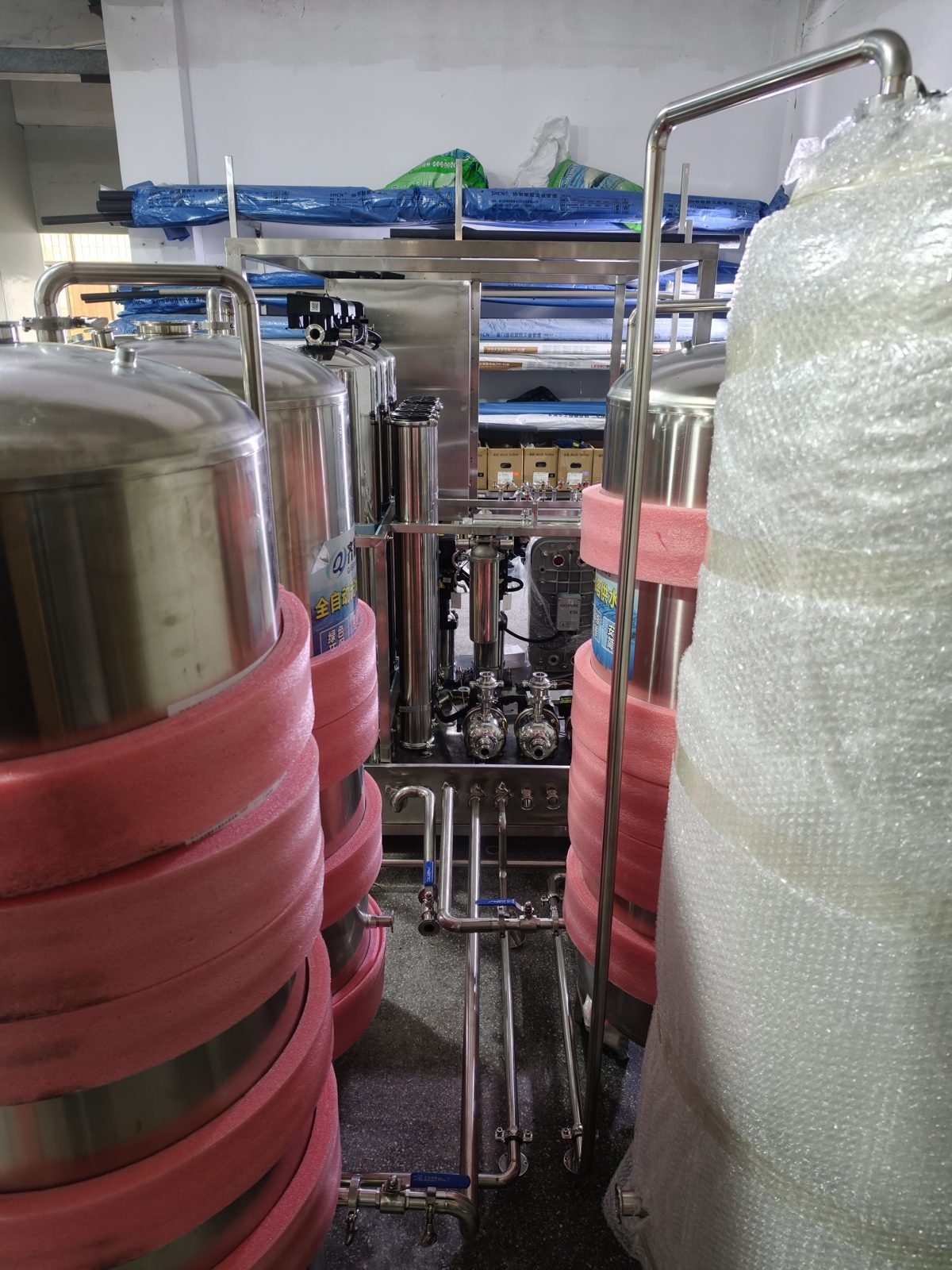
The diagnostic tree: how to tell which fouling you have
Run the plant’s normalised data first. Two numbers tell almost everything:
- Normalised permeate flow decline — flow at design pressure and temperature, compared to start-of-life baseline
- Normalised salt passage increase — feed-conduction-corrected conductivity passage, compared to baseline
Then match the pattern:
| What the data shows | Likely diagnosis |
|---|---|
| Flow ↓, pressure ↑, salt passage roughly stable | Scaling or colloidal — fouling layer adds resistance without changing membrane selectivity |
| Flow ↓, pressure stable, salt passage ↑ | Oxidative damage — element has lost integrity |
| Pressure ↑ across stages (dP), flow ↓ slowly | Biofouling — biofilm plugging the feed spacer |
| Flow ↓, salt passage ↑, all stages equally | Compaction or ageing — mechanical creep in the membrane, end of life |
| Sudden change after a feed event (e.g. river spill) | Event fouling — sample the feed, treat as the matching fouling family |
When the data is ambiguous, take a membrane autopsy — pull one element from the worst-performing vessel, cut it open, and inspect. This is the cheapest diagnostic in the book. A fouling layer that is white and chalky is scale; brown and slimy is biological; grey and gritty is colloidal. Visual inspection takes ten minutes and tells you what no instrument will.
The standard autopsy protocol:
- Pull the lead-end element from the vessel with the highest dP
- Cut the fiberglass shell with a saw, peel it off
- Unroll the element; photograph the feed-side, middle and reject-end
- Sample the foulant layer; test for iron (acid digest + ICP if available), organic carbon, and calcium
- Send the element back to the manufacturer if you want a full analytical report — most vendors offer this free for an element under warranty
When to clean: trigger-based, not calendar-based
A membrane should be cleaned when normalised permeate flow has dropped 10–15% from baseline, OR normalised salt passage has increased 10–15%, OR differential pressure between feed and concentrate has risen 15% — whichever comes first.
These numbers come from membrane manufacturer guidance (DuPont, Toray, LG, Vontron all converge on roughly the same thresholds) and from operating practice. They are conservative. The error mode is waiting too long:
- At 10% decline, a CIP typically restores 90%+ of original performance
- At 20% decline, restoration drops to 70–80%
- At 30% decline, restoration drops to 50% or less, and the foulant layer has often consolidated to the point that no realistic cleaning fully reverses it
By the time flow has visibly halved, the cleaning is largely cosmetic. The membrane has weeks of irreversible fouling baked in.
A common schedule mistake: cleaning on the calendar (every three months, every six months). Calendar-based cleaning either wastes money cleaning a clean membrane, or worse, waits until flow has already declined 25% to clean at all. Track the normalised data; clean on the trend.
(If your operator is running the same recipe every quarter without looking at the data, that’s the symptom. Fix the protocol, not the calendar.)
When to replace: the actual decision tree
Replace the membrane when any one of these is true:
- Normalised salt passage has increased more than 50–100% — the membrane has lost integrity. No cleaning brings salt rejection back.
- Normalised permeate flow has declined more than 30% and stayed there after a correctly-executed CIP — the fouling has consolidated irreversibly.
- Element has visible compromise — telescoping, glue-line failure, O-ring damage, fibreglass shell crack. Mechanical damage does not self-heal.
- Element has reached the end of its service life — typically 5–7 years for brackish water polyamide, 3–5 years for high-pH or high-temperature duty.
If none of these apply and the membrane is underperforming, clean it again with the right chemistry. I’d estimate 70% of the RO membranes I’ve seen replaced at year three could have run to year seven. The waste is enormous — and almost entirely avoidable.
The economics: clean vs replace, on a real cost basis
For a single 8-inch RO element (industry standard, 400 ft² active area):
| Item | Cost (USD equivalent) |
|---|---|
| New element, premium polyamide (LG, Toray, DuPont, Vontron) | $700–1,200 |
| Element changeout labour + freight | $150–300 |
| Lost production during changeout (24–48 h per train) | $500–3,000 per train depending on duty |
| Total replacement cost per element | $1,350–4,500 |
| CIP chemicals, per cleaning | $50–200 |
| CIP downtime (4–8 h per train) | $100–800 per train |
| Total CIP cost per cleaning | $150–1,000 |
The break-even is roughly 5–10 CIPs per element — a typical industrial element will see 5–10 cleanings over its life before replacement becomes necessary. A cleaning regime that works saves the difference between $4,000/element replacement and $200/cleaning × 8 cleanings = $1,600 per element over its life.
For a 100 m³/h train with 27 elements (the worked example from A1), this is roughly $25,000 saved per train over its operating life — for an investment that is the cost of a proper CIP skid plus a few hours of operator training.
Pretreatment: the cheapest membrane protection
Most premature membrane replacement is actually a pretreatment problem wearing a membrane suit. I’ve narrowed it down to three pretreatment issues that cause the majority of premature failures — and they all show up the same way on the data:
Chlorine breakthrough. Free chlorine above 0.1 mg/L destroys a polyamide membrane in weeks. Even municipal tap treated with chlorine will damage an unprotected RO. Specify either dechlorination (activated carbon, sodium bisulfite) or a chlorine-tolerant membrane — the latter is rare and expensive in industrial use.
Hardness breakthrough. Calcium carbonate scales past the antiscalant envelope when hardness spikes or pH drifts. A softener ahead of the RO, sized for peak hardness not average, is the only honest answer in hard-water regions.
Iron and manganese. These foul RO membranes irreversibly and are not removed by antiscalant. If your feed has > 0.1 mg/L iron, specify oxidising filtration (greensand, manganese dioxide) upstream.
For high-purity applications where iron and organic control matters — food and beverage plants and pharmaceutical water — the RO-4000 operates as part of an integrated train with stricter pretreatment upstream.
For the design of the RO system these pretreatments protect, see How to Size an Industrial RO System. For the polishing stage downstream, see EDI vs Mixed-Bed Polisher.
Build a CIP protocol you can actually run
A workable CIP skid needs:
- A clean tank sized for at least one vessel’s worth of permeate (~200 L per 8-inch element × number of elements per vessel)
- A circulation pump delivering 3–4 m³/h per 8-inch vessel, capable of 0.2–0.4 MPa
- Heating to 30–35 °C — non-negotiable for scale and organic cleaning
- Mixed-bed rinse water — never CIP with raw water, you will re-foul the membrane
- pH and conductivity instrumentation on the recirculation loop
- A documented recipe per fouling type — alkaline for organics, acid for scale, surfactant for colloidal
For a 100 m³/h brackish RO train, this is a $5,000–10,000 skid. For the seawater desalination and pharmaceutical RO trains, it is more — but the per-element savings are also larger.
The same skid, with the chemistry shifted toward low-TDS polishing, also covers the periodic cleaning of an EDI ultrapure stack upstream of the polishing mixed bed — see A2 EDI vs Mixed-Bed for the EDI side.
The recipes below are the ones we ship with our RO-4000 systems — also applicable to the UF-2000 CIP cycles when pretreatment fouling carries through.
| Fouling type | Recipe | Conditions |
|---|---|---|
| Scale (CaCO₃, CaSO₄) | 2% citric acid or 0.2% HCl, adjusted to pH 2–4 | 35 °C, 2 h circulation, then 1 h soak, then flush |
| Biofouling / organic | 0.1% NaOH + 0.1% Na₄EDTA at pH 11–12; or 200 ppm NaOCl at pH 10–11 | 30 °C, 1–2 h, then flush to neutral pH |
| Colloidal / silt | 0.1% NaOH + 0.5% anionic surfactant | 35 °C, 1–2 h, then acid flush to remove binder |
| Silica scale (severe) | Hot 0.1% NaOH at pH 13, 45 °C | 4 h; only effective if caught early |
| Mixed / unknown | Sequential: alkaline-oxidant first, then acid | Always end with acid to remove any metal hydroxides redeposited |
Always end with a permeate flush to neutral pH before returning the train to service.
FAQ
How often should I CIP an RO membrane?
On the trend, not the calendar. Clean when normalised permeate flow has dropped 10–15% from baseline, OR salt passage has increased 10–15%, OR inter-stage dP has risen 15%. Calendar-based cleaning either wastes money or waits too long.
Can a damaged polyamide membrane be repaired by cleaning?
No. Oxidative damage, mechanical damage, and glue-line failure are not reversible. Cleaning can only remove fouling layers, not restore a compromised membrane. Once salt passage is up 50%+, replace.
What’s the difference between CIP and CEB?
CEB (chemically enhanced backwash) is a low-concentration, short-contact treatment done on every element at intervals of days to weeks. CIP is a higher-concentration, longer-contact treatment on the whole train, triggered by performance decline. Think of CEB as the daily shower, and CIP as the deep clean when something is actually wrong. CEB prevents the need for CIP; CIP rescues a membrane that CEB alone could not.
How long should a polyamide RO element last?
5–7 years for brackish water at properly controlled feed chemistry and pretreatment. 3–5 years for high-recovery, high-temperature, or chemically aggressive feeds. With poor pretreatment, less than 3 years — and replacement cost becomes a major line item.
How do I tell scale from biofouling without an autopsy?
Trend the data. Scaling produces a sharp drop in permeate flow with rising feed pressure and stable salt passage. Biofouling produces rising inter-stage dP first, then flow drops. If both are happening simultaneously, treat as biofouling first (alkaline + oxidant), then scale (acid).
Can I run CIP at ambient temperature?
You can, but it will take longer and remove less. Don’t bother arguing about whether to heat the tank — just heat it. Most CIP recipes quote 30–35 °C for a reason. Cold-site plants without tank heating routinely fail to restore performance even when the chemistry is right. The capital pays back in the first cleaning that actually works.
Need a CIP protocol for your specific RO train?
Send us your normalised performance data and a description of what you have been seeing — we will tell you what type of fouling you have, what chemistry to run, and whether the element is worth saving.
Get a free membrane assessment →
Or message an engineer on WhatsApp — we reply within 12 hours (GMT+8 working hours).
About the author: Ella Liu — Industrial Water Treatment Specialist at Rong Water (a brand of Shenzhen Qiukanghong Technology Co., Ltd., est. 2012). She has sized RO, UF, deionised, EDI ultrapure and GMP purified water systems for clients across Southeast Asia, the Middle East, Africa and South America. Connect on LinkedIn or email [email protected].