What Data to Prepare Before Requesting a Water Treatment Quote
By Ella Liu — Industrial Water Treatment Specialist at Rong Water. 10+ years sizing RO, UF, deionised, EDI ultrapure and GMP purified water systems.
Every week we receive quote requests that read like this: “I need an RO system, 1 ton per hour, how much?” We can answer it — but the answer will be a range so wide it is useless. Two weeks later the buyer comes back with a water report and a site photo, and the “same” quote changes by 30% or more.
The difference is not the supplier. It is the data.
A water treatment quote is an engineering answer, not a price tag. This article lists exactly what to prepare so that the first number you receive is a number you can plan around — and how a real water test report (below) changes the recommended configuration.
Why suppliers ask so many questions
An RO system is not a commodity you pick from a catalogue. Two plants with identical capacity can need completely different equipment because of what is in the water, what the water is for, and what happens to the reject stream. Ask for a quote without these, and any supplier is either guessing or padding the price to cover the guess.
Here is the checklist we work from. You do not need every item perfect — but each one you add moves your water treatment quote from “indicative” to “firm”.
The checklist: what to send with your inquiry
1. Application and industry. Bottled water, boiler feed, pharmaceutical, electronics, food processing — each has its own rulebook (GMP, FDA, SEMI, GB/T standards). One sentence sets the entire design basis. If you are packaging drinking water, say so: a food and beverage plant and a pharmaceutical water system of the same capacity share almost no components.
2. Required flow rate — and its pattern. Give us the number that matters: m³/h or L/h of usable water at the point of use, plus the daily total if you run in batches. If demand peaks (morning shift, CIP cycles), tell us the peak, not the average. Systems sized on averages disappoint at peaks. Flow is one of the six inputs in our RO sizing guide — the other five are what this checklist covers.
3. A recent water test report. This is the single most valuable document. Not “city water” or “well water” — an actual lab report with ions, pH, conductivity, turbidity, hardness, iron/manganese, chlorine, silica. If you have none, say so and we will tell you the minimum panel to test (usually 10–15 parameters) before we size anything.
4. Target water quality. What do you need at the outlet? Conductivity in µS/cm, resistivity in MΩ·cm, TOC in ppb, hardness in mmol/L, microbial limits — whichever applies. If you do not know, name the standard you must meet and we will derive it.
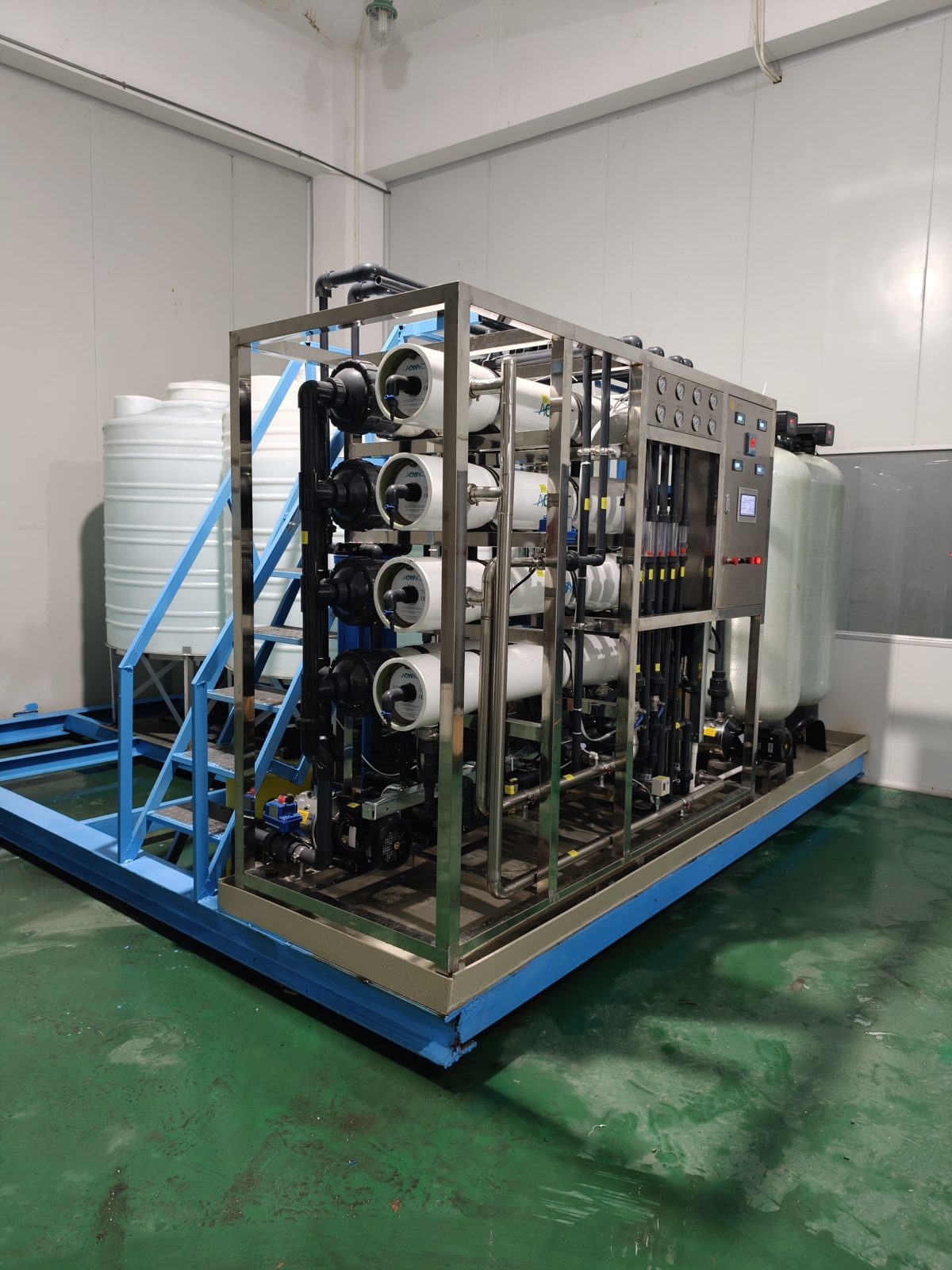
5. Existing infrastructure. Space and layout (length × width × height, floors), whether it is indoor/outdoor, ambient temperature range. A compact skid and a multi-tank plant are different quotes. A rough site sketch is fine — even a marked-up photo of the intended room.
6. Power supply. Voltage, frequency, phases. This drives pump motors and controls, and it is a common cause of late-stage redesign. “400 V / 50 Hz / 3-phase” in your first email saves a week later.
7. Drain and discharge. Where does the reject water go? Is there a sewer, a holding tank, a zero-liquid-discharge requirement? Environmental rules differ by country and this can add a whole polishing section to the plant.
8. Project timeline. When do you need delivery — and is there an installation window? This decides standard equipment vs. engineered-to-order.
9. Budget range (optional but useful). Not to price-gouge — to right-size. A buyer with a clear budget gets a configuration that fits it; without one, we quote the safe (larger) option.
10. Standards and documentation needs. Which certificates your market or auditor expects: CE, ISO, material certs (EN 10204 3.1), FAT/SAT protocols, DQ/IQ/OQ/PQ packages. Asking early avoids re-documentation later.
How to read your water report: the eight numbers that decide the design
You do not need to be a chemist. But when a supplier reads your report, these are the eight numbers they stop at — and knowing what each one triggers in your water treatment quote makes you a faster, better-served buyer.
| Number | What it controls | What it triggers in the design |
|---|---|---|
| Conductivity / TDS | Total dissolved salt load | Sets membrane type, recovery ceiling, and whether one RO pass is enough or a second pass / EDI polishing is needed |
| Hardness (Ca, Mg) | Scaling risk on membranes | Softener or antiscalant dosing; ignored, it shows up as scale in month six |
| Alkalinity | Buffering, CO₂ in permeate | Degasser or pH adjustment after RO |
| Iron & manganese | Fouling and staining | Oxidation-filtration pretreatment — membranes do not forgive iron |
| Free chlorine | Membrane oxidation | Activated carbon or bisulfite dechlorination before the membranes — mandatory, not optional |
| Silica | Scaling at high recovery | Recovery cap, or a silica-removal stage at high-recovery designs |
| Turbidity | Colloidal load | Multimedia filtration depth; high turbidity means heavier pretreatment |
| Temperature | Membrane flux and viscosity | Cold feed water means lower flux per element — the same capacity needs more membrane area |
A report without these is a report a supplier cannot use. A municipal water quality summary from your utility is often a valid starting point — but it rarely includes chlorine and silica, the two numbers that most often change the configuration.
A real example: what a water report tells us
Below is an actual feed water report from a completed project in Vietnam (report number masked). Read what an engineer reads:
| Parameter | Value | What it means for the design |
|---|---|---|
| Residual chlorine | 0.33 mg/L | Above the ~0.1 mg/L limit for polyamide RO membranes → activated carbon dechlorination stage is mandatory, not optional |
| pH | 5.75 (acidic) | Low pH affects scaling chemistry and material corrosion checks — antiscalant dosing and material selection get a second look |
| Turbidity | 0.23 NTU | Low — light pretreatment is fine (no heavy clarification needed) |
| E. coli | < 1 | Microbiologically clean source — but storage and loop design still need UV/biocontrol |
| Arsenic | ND | No special arsenic removal scope |
Same plant, two configurations. Without the report, a supplier quotes a generic train — and a generic water treatment quote. With the report, the chlorine number alone decides that carbon filtration sits before the membranes — protecting a membrane set that costs a meaningful fraction of the whole system. That is the difference a single document makes.
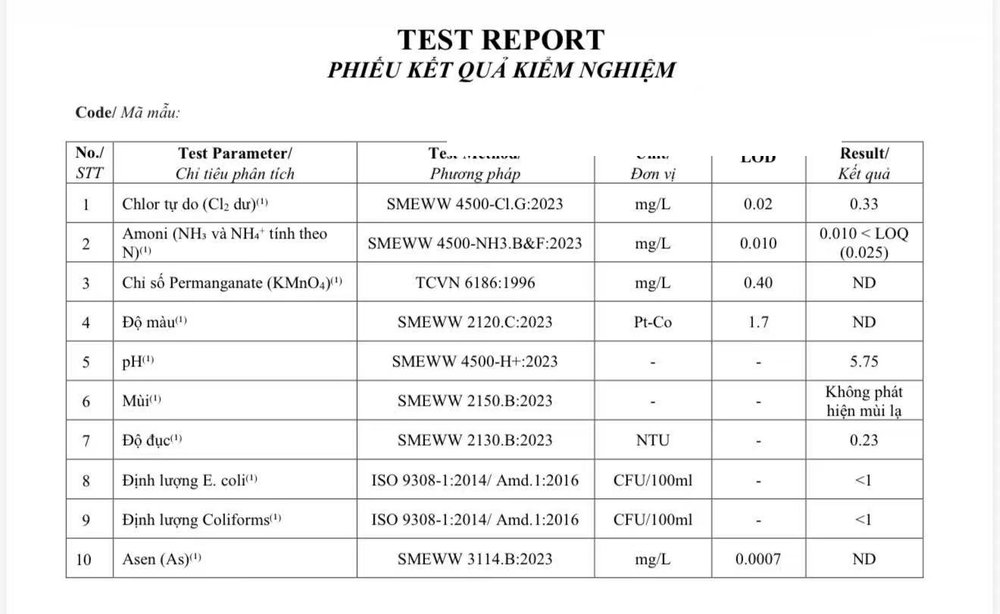
This is an actual feed water report from a completed project in Vietnam (sample code masked) — exactly the document we hope you send with your inquiry.
Why the cheap quote is usually the expensive one
When two quotes differ by 20–30%, the difference is almost never profit. It is scope. And missing scope has a pattern — three failure modes we see again and again:
No dechlorination stage. The quote is 8% cheaper because the carbon filter “was not in the spec”. Polyamide membranes oxidise; the buyer replaces a membrane set inside 18 months and the savings are gone twice over.
Sized on average demand. The quote matched the average flow you asked for. At peak, the plant runs short, and the fix is a second skid or an oversized add-on at emergency prices.
Wrong materials for the water. The quote assumed standard stainless on an acidic feed. Corrosion findings at FAT, re-engineering, warranty arguments — all paid for by whoever signed the purchase order.
None of these are dishonest. They are quotes written without data. The checklist above is how you protect yourself from them in any water treatment quote you receive — whatever supplier you eventually choose.

Five mistakes that cost buyers two weeks
- Sending a photo of a report instead of the PDF. Illegible digits, missing units, no test method. We will ask for the file anyway — you have lost three days.
- Quoting average demand instead of peak. See above. If you run batches, give us the batch profile.
- Hiding the budget. It does not make the quote cheaper — it makes it wrong. A stated range gets you a configuration that fits; silence gets you the safe (larger) option.
- “City water” as the entire water description. It tells a supplier nothing. Chlorine, hardness, and silica in municipal water vary street by street.
- Asking for a price before defining the application. “How much is a 1 t/h RO?” is not answerable as an engineering question. “1 t/h permeate for a bottled water line, feed is municipal, report attached” is.
Words you will see in the quote — and what they mean
- µS/cm vs MΩ·cm — two ways to say the same thing, inverted. Ultrapure water is quoted as 18.2 MΩ·cm (≈ 0.055 µS/cm); drinking-grade RO permeate is usually 10–50 µS/cm.
- Recovery — the share of feed water that becomes permeate. Typical brackish RO runs 70–80%; the rest leaves as reject (concentrate).
- SDI₁₅ — silt density index, the standard fouling test for RO feed. Below 5 is normal; above 5 means heavier pretreatment.
- CIP — clean-in-place: circulating cleaning chemicals through the membranes without dismantling anything.
- FAT / SAT — factory / site acceptance tests. FAT is where you should witness the numbers yourself before shipment.
- DQ / IQ / OQ / PQ — design, installation, operational, performance qualification: the pharmaceutical documentation ladder. If your auditor asks for them, say so at quote stage, not at delivery.
What happens after you send the data
With the checklist complete, a serious supplier can come back within 24 hours with a water treatment quote that includes:
- a process flow diagram (every stage, every tank, every instrument),
- the equipment list with models and materials,
- key performance targets (recovery, conductivity, capacity) you can hold them to,
- commercial terms: price, lead time, payment terms, warranty.
If a water treatment quote arrives in an hour with none of the above, it is a price, not an engineering answer.
FAQ
What if I do not have a water report?
Say so in your first email. We will tell you the minimum panel to test — usually 10–15 parameters — and in many markets a recent municipal water quality report from your utility is a valid starting point until a lab report exists.
Can I get a firm quote from a photo of my site?
An indicative one, yes. A firm one, no — layout decides skid vs multi-tank, pipe runs, and access for maintenance. One wide photo plus rough dimensions is enough for a firm quote.
Why did the price change after I sent the report?
Because the report changed the scope — a dechlorination stage, different materials, an antiscalant skid. The water treatment quote did not get more expensive; it got honest. Compare the old and new scope line by line and you will see exactly what changed and why.
Is the cheapest quote always the worst?
No — sometimes it is a better factory or a leaner design. But compare scope line by line using the checklist above: stages, materials, instrumentation, documentation, warranty. A quote missing stages is not cheaper; it is incomplete.
Do you work under NDA?
Yes — we are used to exchanging drawings and specifications under a mutual NDA. Ask in your first email and we will send ours with the water treatment quote.
What lead time should I plan for?
Standard configurations ship in 3–5 weeks; engineered-to-order trains run 6–10 weeks depending on the polishing scope. Tell us your installation window in the first email and we will tell you honestly whether it is realistic — a missed window costs more than a slower quote.
Ready to request your water treatment quote?
Send us your water report (or tell us you need one) plus items 1–8 above through our quote request form — or add several systems to the quote list and submit one water treatment quote request for everything. We answer complete inquiries within 24 hours, in English, Spanish, Chinese or Arabic.
Rong Water — factory-direct water treatment systems since 2012. 1,500+ systems delivered to 60+ countries.
By Ella Liu — Industrial Water Treatment Specialist at Rong Water (a brand of Shenzhen Qiukanghong Technology Co., Ltd., est. 2012). 10+ years sizing RO, UF, deionised, EDI ultrapure and GMP purified water systems for clients across Southeast Asia, the Middle East, Africa and South America. Connect on LinkedIn or email [email protected].