Process Water & Demineralised Water Systems for Chemical & Petrochemical Plants — Built for Variable Feed
RO + softening / EDI trains engineered for chemical plants where the raw water changes with the season and the real enemy is scaling, fouling and corrosion — not a resistivity number. Capacities from 5 t/h utility stations to 200+ t/h multi-train demineralised water plants, with CIP skids, anti-scalant dosing and corrosion-controlled wetted materials.
Request a Process Water Sizing Sheet Talk to a process water engineer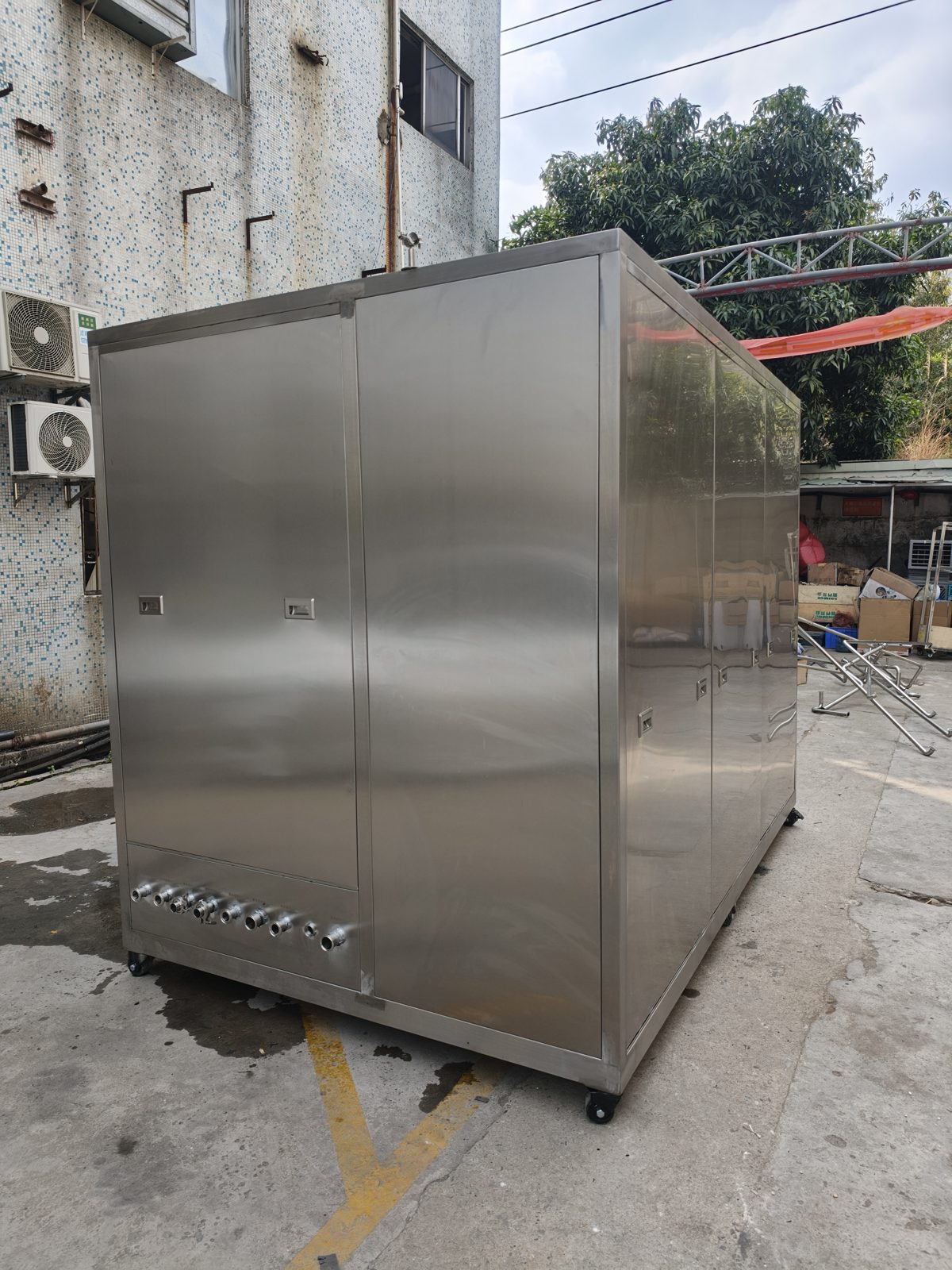
Why Chemical Plants Fail on Water Variability, Not on Purity
A pharmaceutical loop is judged on a resistivity number. A chemical plant is judged on whether the RO train still delivers design flow in the third month of the wet season. River water carries 10× the suspended solids in flood months; a well drifts in iron and hardness; a shared industrial park supply changes every time a neighbour starts a batch discharge. Most under-performing chemical water systems we are called to rescue were sized off a single water analysis taken on a good day. We design to the worst month in your record, then dose and clean for it.
| What you measure | Why it matters | Target we hold |
|---|---|---|
| SDI₁₅ (RO feed) | Colloidal fouling, first-stage ΔP rise | < 5 (UF-polished: < 3) |
| Free chlorine | Oxidises polyamide RO membrane irreversibly | < 0.1 ppm (ORP < 250 mV) |
| Total hardness | CaCO₃ / CaSO₄ scale on membrane and exchanger | < 0.03 mmol/L after softening |
| Silica (concentrate) | Irreversible scale, not removed by acid CIP alone | < 150 mg/L in RO concentrate |
| COD / TOC | Biofouling and organic fouling of RO | COD < 3 mg/L (surface water: UF + AC) |
| Iron / manganese | Oxide fouling, catalyses oxidation | Fe < 0.1 ppm, Mn < 0.05 ppm |
| Langelier index (cooling) | Balance between scale and corrosion | LSI −0.5 to +0.5 |
| Demineralised conductivity | Product spec for process / boiler feed | < 5 µS/cm (HP boiler: < 0.2 µS/cm) |
Our Standard Process Train for Chemical & Petrochemical Water
| Stage | Equipment | Function | Key spec |
|---|---|---|---|
| ① Equalisation | Raw water tank + mixer | Buffer seasonal / batch-to-batch variability | 8–24 h retention |
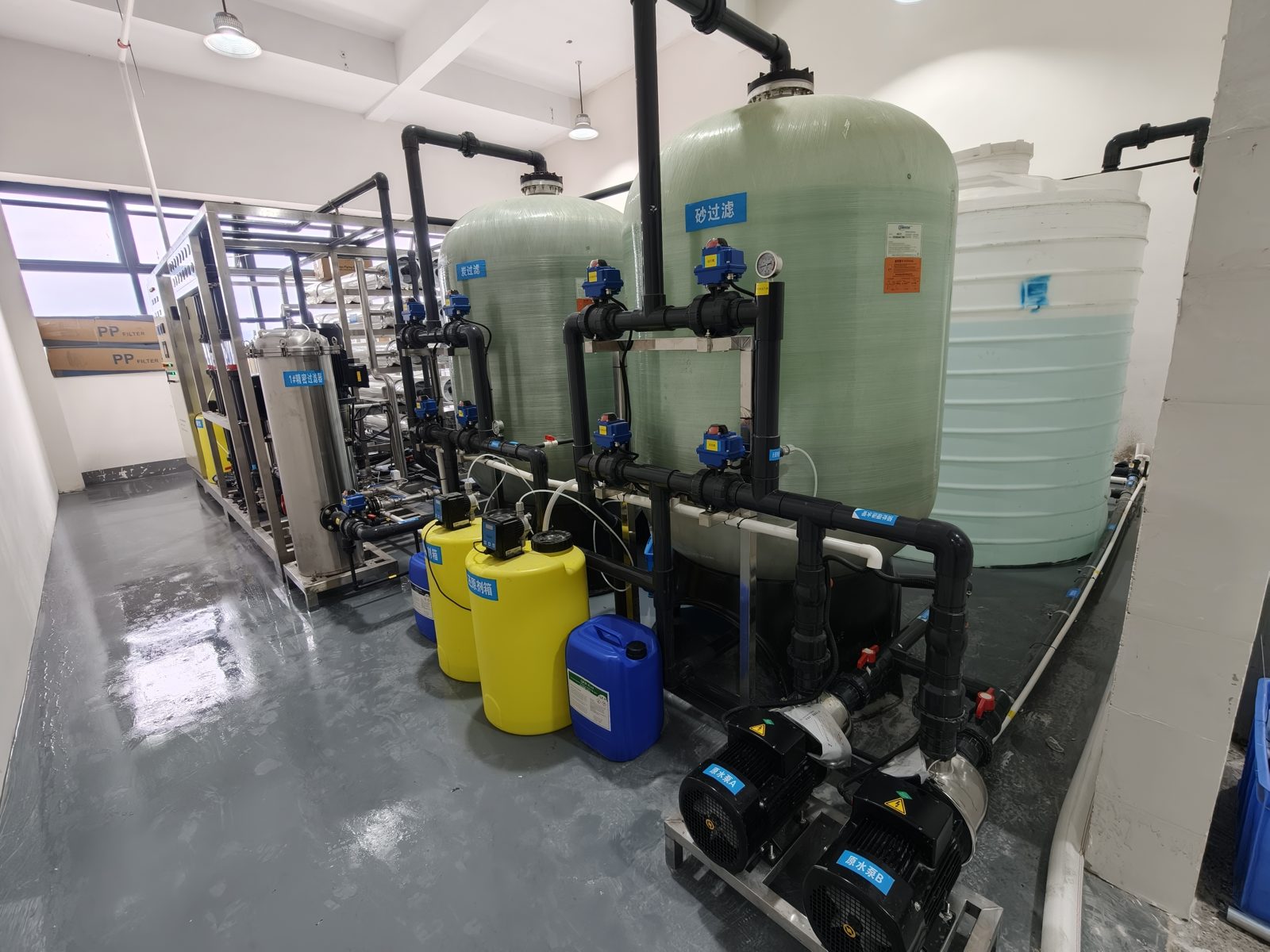
| ② Clarification | Coagulation + flocculation + MMF, or UF | Remove suspended solids, cut SDI | SDI₁₅ < 5 (UF: < 3) |
| ③ Dechlorination | Activated carbon + SMBS dosing | Protect polyamide RO from oxidation | Free Cl₂ < 0.1 ppm |
| ④ Scale control | Softener (WS) and/or anti-scalant dosing | Keep CaCO₃ / CaSO₄ / silica in solution | Hardness < 0.03 mmol/L |
| ⑤ Guard filtration | 5 µm cartridge filter | Last-line particle protection | ΔP-monitored, scheduled change |
| ⑥ RO | DOW™ BW30-400 / brackish-high-TDS element | Bulk demineralisation, 95–99% salt rejection | Recovery 70–80% |
| ⑦ Polishing | EDI or mixed bed | Demineralised water to spec | < 5 µS/cm (MB: < 0.2 µS/cm) |
| ⑧ Deaeration | Vacuum degasser / deaerator | Remove CO₂ and O₂ before boiler feed | O₂ < 15 ppb for HP boilers |
| ⑨ CIP skid | CIP tank + pump + cartridge | Clean membranes without dismantling | Low-pH / high-pH / biocide cycles |
| ⑩ Concentrate & reuse | Concentrate equalisation + WR reclaim skid | Cut discharge volume, recover water | 50–70% additional recovery |
Not every plant needs all ten. Utility stations feeding only a cooling tower stop at ④; demineralised process water for resin or fine chemicals runs ①–⑦; high-pressure boiler feed adds ⑧.
Materials We Select for Chemical Compatibility
| Wetted part | Material | Why it is chosen |
|---|---|---|
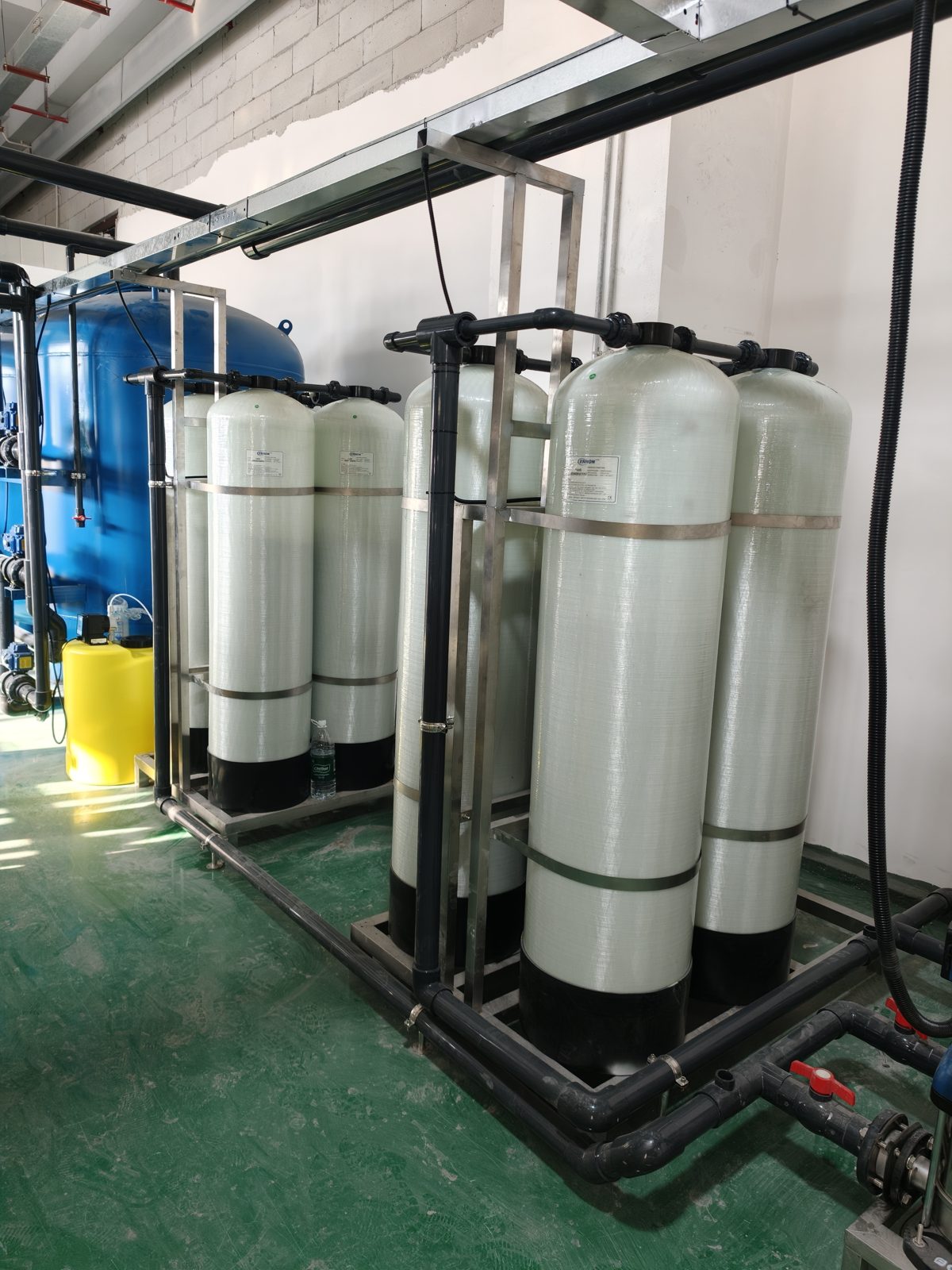
| RO pressure vessels | FRP with vinyl ester liner | Chloride-resistant, no rust |
| High-TDS / hot lines | SS316L | Chloride pitting resistance up to ~1,000 ppm Cl⁻ |
| Ambient demin / utility | PP / PVC-U | Cost-effective, chemically inert to demin water |
| Solvent or high-purity contact | PVDF / PTFE-lined | Broad chemical compatibility |
| Tanks | HDPE-lined CS, PP, or FRP | No metal contact, no leachables |
| Valves | Diaphragm (EPDM / PTFE) or PVDF ball | No dead legs, serviceable in place |
| Pumps | SS316L or duplex vertical multistage | Handles variable suction and dosing by-products |
Material certificates (MTRs) and EN 10204 3.1 documents ship with every skid; we will not substitute a lower alloy to hit a price point without telling you in writing.
Standard Capacities (Chemical & Petrochemical)
| Model | Output | Power | Typical application |
|---|---|---|---|
| CH-5 | 5 t/h | 18 kW | Utility station, cooling make-up |
| CH-10 | 10 t/h | 32 kW | Small batch plant, boiler feed |
| CH-30 | 30 t/h | 85 kW | Specialty chemicals, resin production |
| CH-50 | 50 t/h | 140 kW | Mid-size continuous plant + reuse skid |
| CH-100 | 100 t/h | 270 kW | Petrochemical utility block, multi-train |
| CH-200+ | Custom | Custom | Integrated refinery / chemical park |
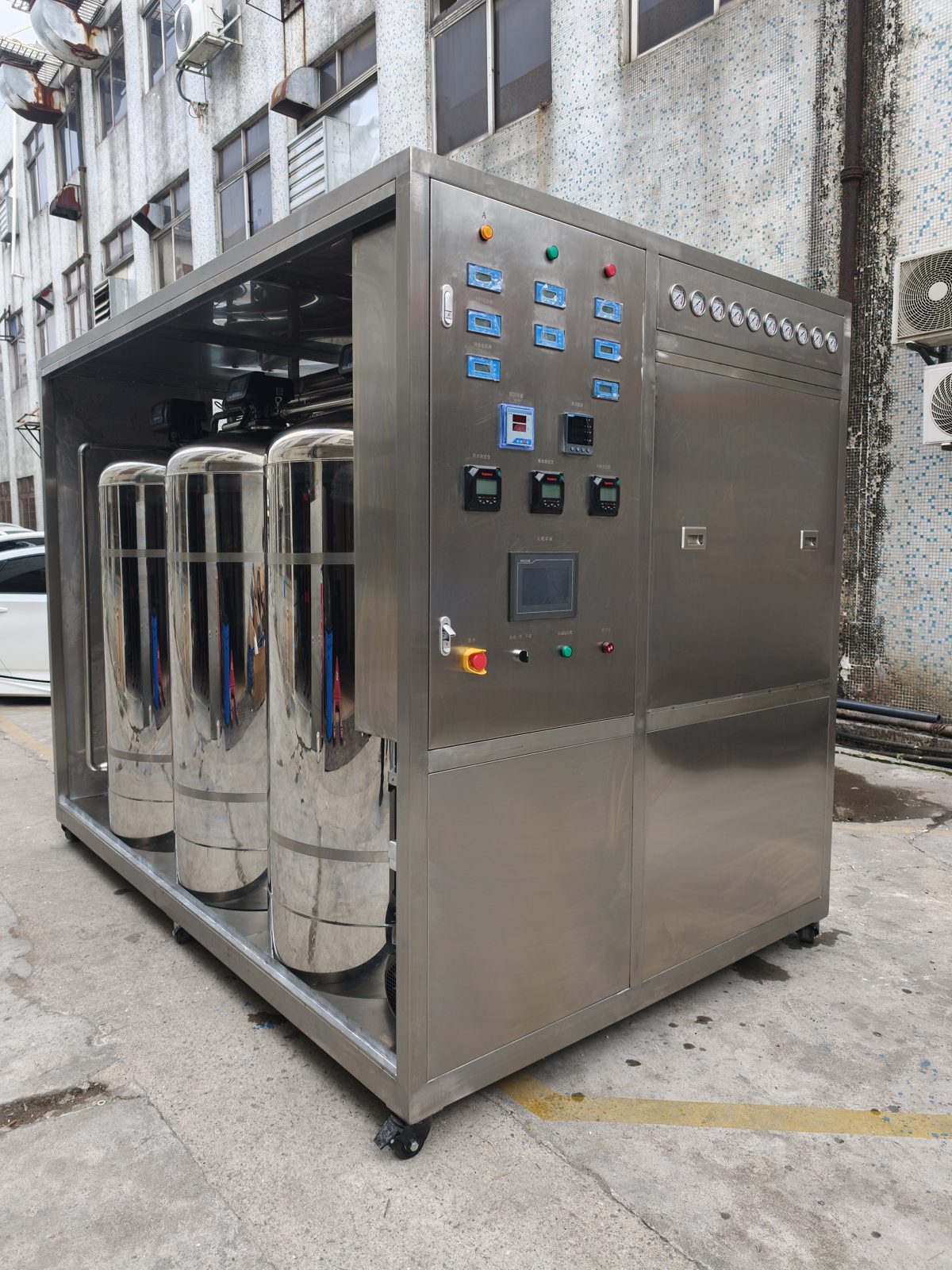
Skids are pre-piped, pre-wired and FAT-tested in our factory. On-site scope is limited to tie-ins, dosing commissioning and operator training — typically 3–4 weeks for a 30 t/h system.
Engineering Reference — 30 t/h Demineralised Water + 80 t/h Cooling Make-Up
| Parameter | Design value |
|---|---|
| Feed (worst month) | River water, TDS ≈ 620 ppm, hardness ≈ 4.2 mmol/L, silica ≈ 18 ppm, COD ≈ 6 mg/L |
| Demineralised demand | 30 t/h continuous, 1.3× peak |
| Cooling make-up | 80 t/h, side-stream softened + dosed |
| Product quality | Conductivity < 5 µS/cm, silica < 0.1 ppm, hardness < 0.03 mmol/L |
| RO configuration | 2 trains × 15 t/h, 75% recovery, anti-scalant dosed |
| Polishing | EDI, continuous, no acid/caustic regeneration |
| Concentrate | Equalised, 60% returned via WR-3000 reclaim skid |
| Controls | Siemens S7-1500, Modbus TCP / Profinet to plant DCS |
| Delivery | 14–18 weeks from PO |
5 Pitfalls We Design Around
- Sizing off one water analysis — we ask for at least 12 months (or quarterly worst-month data). Systems sized on a best-case analysis lose 20–40% of design flow in the wet season.
- Chlorine breakthrough killing the RO — AC bed alone is not enough; we add SMBS dosing with ORP interlock and a membrane warranty clause tied to free-chlorine logging.
- Silica scaling in the second stage — silica is the constraint on recovery, not hardness. We cap recovery against concentrate silica, and size caustic CIP for silica when needed.
- Organic fouling from river or recycled water — UF + AC ahead of RO, plus a documented enzymatic / high-pH cleaning regime in the O&M manual.
- Concentrate with nowhere to go — we size a WR reclaim skid or at minimum an equalisation + controlled-discharge arrangement at design stage, because retrofitting concentrate treatment is always more expensive.
Standards We Design To
- ASTM D4189 — Silt Density Index (SDI) of RO feed water
- ASTM D4195 — Water analysis guide for reverse osmosis applications
- ASTM D1193 — Reagent water grades (for on-site QC laboratory loops)
- ASTM D1125 / D1293 — Conductivity and pH of water
- ISO 8044 — Corrosion of metals and alloys, basic terms (material selection basis)
- ASTM G31 / NACE guidance — corrosion evaluation for wetted-material selection
- CE / PED where applicable, ISO 9001 / ISO 14001 / ISO 45001 certified factory
Frequently Asked Questions
Q1. Our raw water changes a lot between seasons. Can one system cope?
Yes, but only if it is sized to the worst month, not the average. We design the pretreatment (clarification/UF + softening) to the worst-case SDI, hardness and COD, then use variable-frequency high-pressure pumps and recovery control to run efficiently in the good months. Send us 12 months of data if you have it.
Q2. Do we need UF before RO?
For municipal or good well water, multimedia filtration plus cartridge is enough. For river, surface or recycled water, or whenever SDI₁₅ exceeds about 5, UF is the reliable way to protect the RO. It costs more up front and pays back in membrane life and stable flow.
Q3. How do you protect the RO from chlorine?
Two layers: an activated carbon bed for bulk removal, plus sodium bisulfite (SMBS) dosing with an ORP interlock that stops the RO if free chlorine rises above 0.1 ppm. We log ORP so membrane warranty claims can be evidenced.
Q4. What recovery can we realistically run?
70–80% for most brackish feeds. The binding constraint is usually silica or calcium sulfate in the concentrate, not hardness. We run the scaling calculation on your worst-month analysis and cap recovery accordingly rather than quoting a generic number.
Q5. Can you treat and reduce our RO concentrate?
Yes. A WR-3000 reclaim skid typically returns a further 50–70% of the concentrate stream to the front of the plant. Where discharge limits are tight, we design toward minimal-liquid or zero-liquid discharge — that is a separate study, not a catalogue item.
Q6. EDI or mixed bed for polishing?
EDI if you want continuous operation with no acid and caustic on site, and your feed is already low in hardness and CO₂. Mixed bed if you need the very lowest conductivity (< 0.2 µS/cm) or your upstream is variable. Many chemical plants run EDI for the bulk and keep a small MB polisher as a guard.
Q7. How is the system cleaned?
A dedicated CIP skid with low-pH, high-pH and biocide cycles, plumbed to each RO stage. Cleaning intervals depend on your feed: typical chemical plants clean every 3–6 months. We provide the cleaning procedure and the chemical quantities in the O&M manual.
Q8. What is the warranty and spare-parts position?
12 months on the complete system plus 36 months on critical parts (RO membranes, EDI stacks, high-pressure pumps). We ship a 2-year consumables forecast with every system and stock standard spares for 7-day international dispatch.
Related Equipment & Industries
RO-4000 — Reverse Osmosis · WS-2000 — Water Softener · DI-1000 — Deionized Water · UF-2000 — Ultrafiltration · WR-3000 — Water Reuse
Power Plant (Utility Make-Up) · Boiler & Steam (Industrial) · Seawater Desalination
Ready to Size Your Process Water System?
Send 12 months of raw-water data — we return a free scaling and recovery calculation, plus an anti-scalant dosing sheet, within 24 h.
Request a Process Water Sizing Sheet Talk to a process water engineerTechnical content reviewed by Ella Liu, Industrial Water Treatment Specialist at Rong Water — 10+ years sizing RO, softening and demineralised water systems for chemical and petrochemical clients.